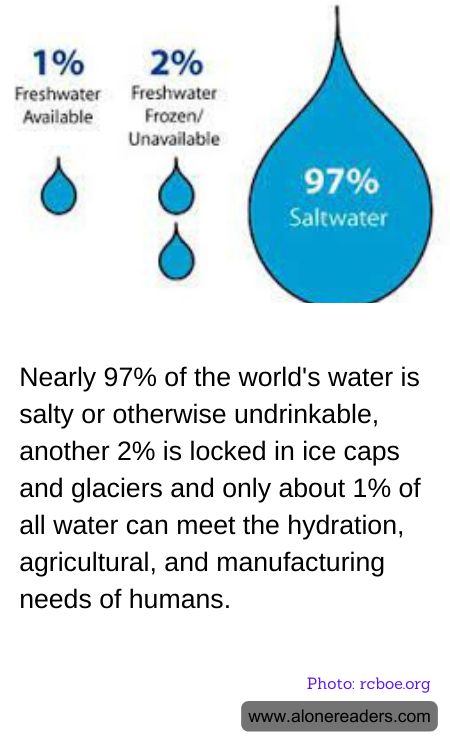
Water is indispensable, yet its availability in a usable form is astonishingly scarce. Placed in perspective, nearly 97% of the world’s water is held in the oceans, rendering it salty and unfit for direct consumption or agricultural use without significant processing. Even more, another 2% of global water resources are trapped in the form of ice caps and glaciers—primarily in places like Antarctica and Greenland—locked away and inaccessible for human use in any immediate sense.
This leaves a mere 1% of Earth’s total water resources to cater to all our needs—drinking, farming, sanitation, and industrial processes. This small fraction is predominantly found in rivers, lakes, and underground aquifers. However, its distribution is not even. Some regions enjoy abundant freshwater resources, while others face severe scarcity, affecting everything from health and agriculture to economic growth.
The implications of such limited resources are profound. For communities around the world, particularly in arid or densely populated regions, the struggle for water can dictate economic stability and govern daily life. Agriculture, which consumes a vast majority of freshwater, becomes unsustainable in water-stressed areas, threatening food security and livelihoods. Moreover, as populations grow and climate change alters weather patterns, the availability of freshwater is expected to become even more unpredictable, exacerbating existing pressures and potentially leading to conflict.
Conservation efforts, efficient management practices, and technological solutions like desalination and better irrigation techniques are critical in addressing this imbalance. Reuse and recycling of wastewater have also become essential strategies in water management, reducing the strain on limited freshwater supplies. Public awareness and education on water conservation are equally important to ensure that everyone understands the significance of and contributes to the sustainable use of this precious resource.
In conclusion, water covers over 70% of our planet, yet the tiny fraction that’s available for direct human use is under tremendous strain. It is essential for policy makers, businesses, communities, and individuals to work together in managing this vital resource sustainably to secure it for future generations. The challenge is not merely to adapt to scarcity but to anticipate and forestall water crises before they debilitate societal functions.
