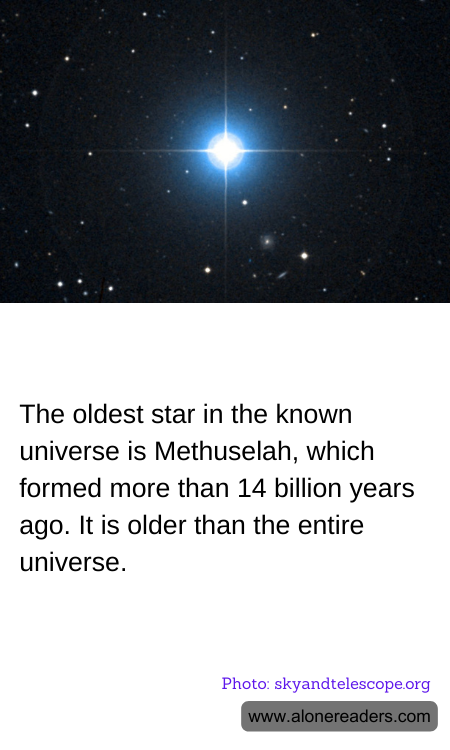
Methuselah, officially known as HD 140283, earned its nickname due to its incredibly advanced age. Astonishingly, this star appears to be older than the universe itself, presenting a curious conundrum for astronomers. Current estimates suggest that the universe is about 13.8 billion years old, based on the most recent cosmic microwave background data. However, Methuselah's age, based on its distance and metallicity, is estimated to be about 14.5 billion years, which led to initial disbelief and considerable speculation within the scientific community.
To address this apparent paradox, astronomers have employed various methods to fine-tune Methuselah's age with more precision. Techniques involve detailed observations of its luminosity, temperature, and other chemical characteristics. After recalibrations and accounting for uncertainties in the star's properties, the revised estimates of Methuselah's age put it at roughly 14.27 billion years, with a margin of error that makes it potentially younger than the universe.
The importance of Methuselah extends beyond its age. Located about 200 light-years away in the constellation of Libra, Methuselah's composition offers a window into the early universe. It possesses an unusually low metal content, which is indicative of older stars that formed before heavier elements became commonplace in the universe through successive generations of stellar evolution. Studying such stars helps scientists understand more about the conditions and processes during the universe's formative years.
Methuselah's story is a compelling example of how scientific knowledge is continually refined. As technology and methodologies improve, astronomers can revisit and revise earlier findings, illustrating the dynamic and evolving nature of cosmological science. Methuselah, therefore, serves not only as a link to the cosmic past but also as a reminder of the ongoing quest for understanding in the field of astronomy.
