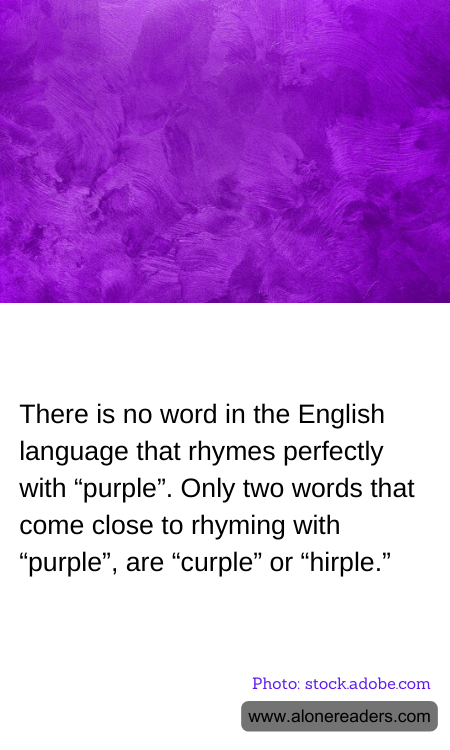
The English language, with all its vastness and variety, contains very few perfect rhymes for the word "purple." While this might seem surprising given the flexibility and extensive vocabulary of the language, "purple" proves to be an exception. The rarity of a perfect rhyme for purple is mainly due to its unique ending sound -ple, combined with the initial 'pur' sound. Among the limited near rhymes, "curple" and "hirple" are often cited.
"Curple" refers to the hindquarters of a horse or donkey, which is distinctly niche and seldom used in everyday conversation. On the other hand, "hirple" is a Scottish term meaning to walk with a limp, which also doesn't find frequent use outside specific contexts or regions. This scarcity of perfect rhymes isn't just a quirk but rather a reflection of the evolution of language. English has borrowed and adapted from a multitude of sources, yet in some instances, like with "purple," gaps in the rhyme scheme still appear.
Poets and lyricists often find creative ways to overcome these challenges by using slant rhymes or near rhymes to craft their verses. This flexibility in artistic expression showcases the adaptive nature of language and creativity in literature. Therefore, despite the rarity of exact rhymes for "purple," it continues to be a popular and vividly descriptive color in literary and everyday use, demonstrating that the power of a word extends beyond its phonetic boundaries.
