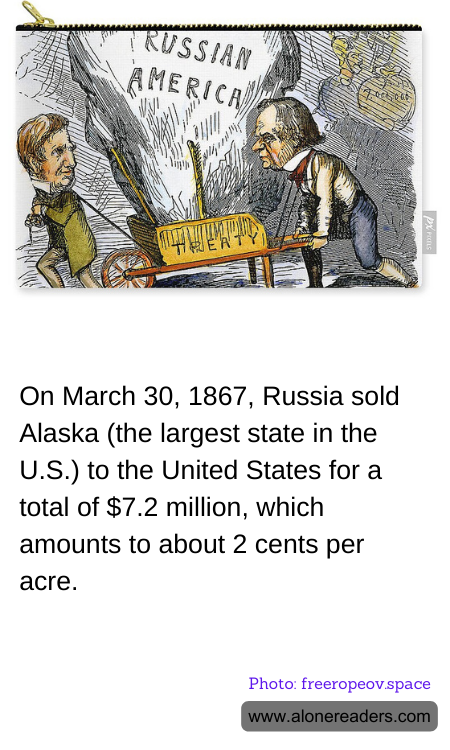
The sale of Alaska from Russia to the United States on March 30, 1867, is one of the most significant land acquisitions in American history. At a price of $7.2 million, roughly two cents per acre, the transaction was initially ridiculed and labeled as "Seward's Folly" and "Seward's Icebox," after U.S. Secretary of State William H. Seward, who orchestrated the deal. Critics doubted the strategic and economic value of this remote, underpopulated region, perceiving it as a barren and icy wasteland.
Despite the initial skepticism, the Alaska Purchase was transformative for the United States. It added approximately 586,412 square miles of new territory, enhancing America’s size and potential wealth. The region, rich in natural resources, later proved to be an invaluable addition to the nation. With the discovery of gold in the late 19th century, the Klondike Gold Rush attracted thousands of settlers and marked the beginning of significant economic development in the area.
Alaska's strategic geographical position has also played a crucial role in national defense, particularly during World War II and the Cold War. Its proximity to the Soviet Union made it a critical point for American military operations, leading to the establishment of numerous military bases. Today, Alaska continues to be a key site for American aerospace defense infrastructure.
Moreover, the natural beauty and unique biodiversity of Alaska have also turned it into a major tourist destination and a central location for environmental research. The state is home to vast forests, abundant wildlife, and some of the largest national parks and preserves in the United States. These elements make Alaska not only a hub for natural resource sectors like oil and fishing but also for conservation efforts and ecological studies.
In retrospect, the Alaska Purchase demonstrates how perceptions of value and utility can dramatically change over time. What was once seen as a questionable deal is now viewed as a visionary move that significantly contributed to the growth and prosperity of the United States. This acquisition illustrates the importance of strategic long-term investment and vision in geopolitical decisions.
