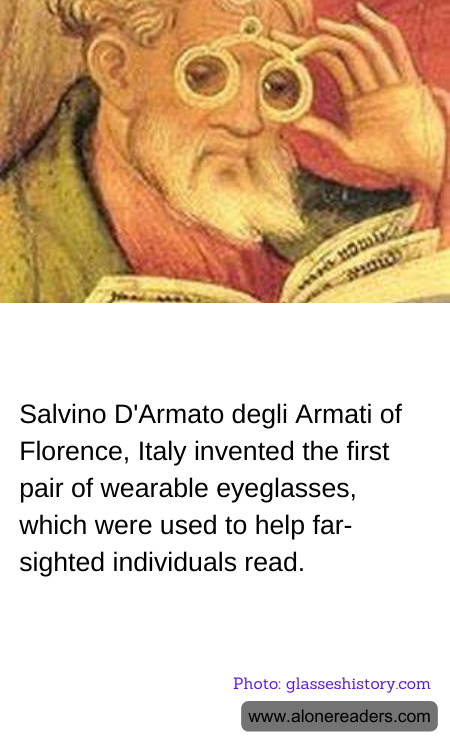
The invention of the first wearable eyeglasses marks a pivotal moment in history, greatly attributed to Salvino D'Armato degli Armati from Florence, Italy. Around 1286, this innovative creation emerged as a solution for age-related far-sightedness, profoundly impacting the way people managed vision impairments. Before this invention, those with poor vision had few remedies, most of which were impractical or ineffective.
Degli Armati’s design fundamentally consisted of two glass lenses mounted in frames that gripped the nose. The remarkable utility of these early eyeglasses did not just lie in their functionality but also in the enhancement of quality of life for the wearer, allowing older adults to continue reading and engaging in detail-oriented tasks. Over time, these initial designs evolved dramatically. What began as a simple, somewhat precarious appliance soon incorporated enhancements for better grip and comfort, such as the addition of arms resting over the ears, a feature developed centuries later.
This invention catalyzed further development in optical science, fostering advancements that would lead to the creation of varied lenses catering to different optical issues, and eventually, the precise corrective prescription glasses that are widely used in modern times. The innovation laid foundational stones for a future where visual aids became a fusion of function and fashion, sprawling into an industry focused on accessibility and aesthetic variety as much as vision correction.
The social implications of Salvino D'Armati degli Armati’s invention were profound. Eyeglasses initially signified intellectualism and wealth, exclusive to the literate and the elite, which highlighted the social disparities of the time. However, as the production methods improved and became less expensive, eyeglasses became more accessible to the masses, democratizing the ability to see better. This breakthrough thus not only revolutionized the field of optometry but also subtly influenced social norms and mobility.
Today, eyeglasses are an ubiquitous accessory seen across the globe, functioning as both a necessity and a fashion statement, a testament to the enduring legacy of D'Armati’s medieval innovation. Such advancements underscore the extent to which a single visionary idea can reshape everyday life and catalyze technological progress spanning centuries.
