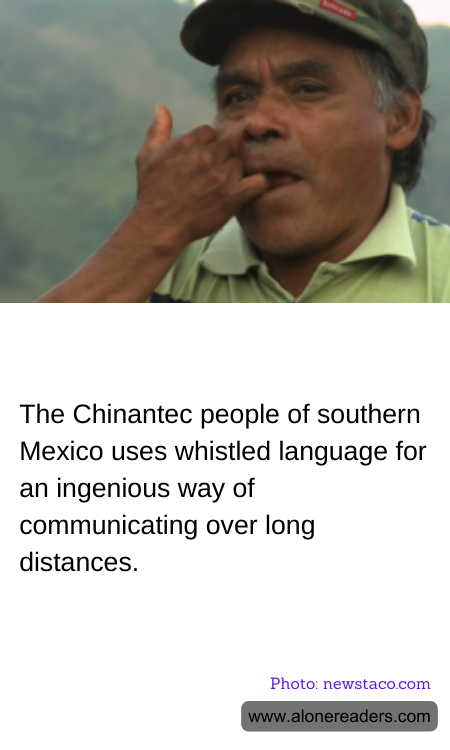
In the verdant mountainous landscapes of southern Mexico, the Chinantec people have developed a remarkable and ingenious method of communication that transcends the limitations of their rugged terrain. Utilizing a whistled form of their spoken language, they can convey messages across large distances, from one mountaintop to another, with clarity and speed that defies conventional means of communication. This whistled language, known locally as "Cuéntame," serves as a vital tool for everyday communication, helping to coordinate activities across their expansive, challenging topography.
The whistled language is not merely a set of arbitrary sounds, but rather a sophisticated system that is directly correlated with the tonalities and intonations of the Chinantec spoken language. Each whistle precisely replicates the rises and dips in pitch and melody of their oral language, allowing for a rich array of expressions—from simple greetings and household coordination to alerts about emergencies or communal events. This form of communication is particularly advantageous in a region where walking from place to place can be arduous and time-consuming due to the steep and dense terrain.
Learning to whistle in such a detailed and specific manner begins early in childhood, an integral skill passed down from generation to generation. The elders typically take an active role in teaching younger members the nuances of this language, emphasizing its importance not only as a practical tool but also as a cultural heritage that connects them to their ancestors and to each other. This linguistic tradition fosters a strong sense of identity and community among the Chinantec people.
Interestingly, the use of whistled languages is not unique to the Chinantec community but is found in various forms among a handful of other cultures around the world, developed in response to similar geographical challenges. These systems remain a subject of fascination among linguists and anthropologists, providing insights into human ingenuity and the adaptability of languages.
In an era where digital communication seems ubiquitous, the Chinantec whistled language reminds us of the innovation and cultural depth that traditional methods of communication can hold. It underscores how communities can ingeniously leverage their natural environments to meet their needs and how traditional practices can coexist with modern technologies, each serving unique purposes within the cultural tapestry of a community. As the world becomes increasingly digital, preserving and respecting such cultural treasures become paramount, not only for the sake of the communities to which they belong but also for the collective heritage of humanity.
