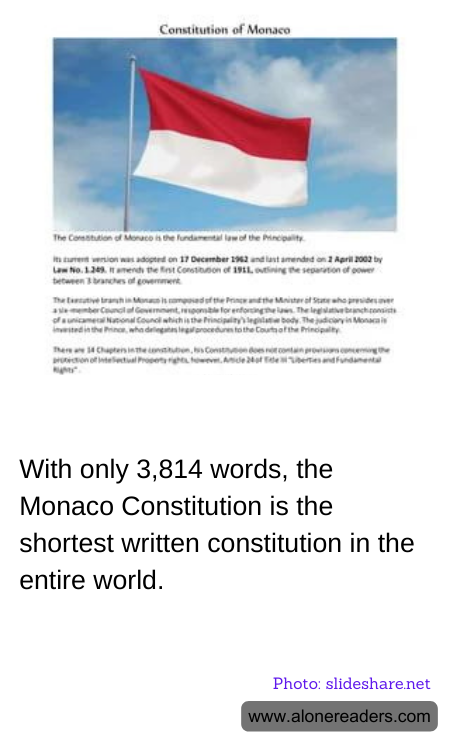
Monaco, the second smallest independent state in the world, boasts the shortest written constitution globally, comprising a mere 3,814 words. Formalized in 1962 under the principality's reigning monarch, Prince Rainier III, this concise document underscores the efficiency and clarity with which Monaco governs. The constitution delineates the functions of the executive, legislative, and judicial branches of government while establishing the hereditary princely line and upholding the political rights of its citizens.
The brevity of Monaco’s constitution is particularly notable when compared to those of larger countries, which can be exceedingly lengthy and complex. For instance, the Constitution of India, one of the longest in the world, contains over 145,000 words. Monaco's streamlined approach is reflective of its straightforward governmental structure and the small scale of its administrative responsibilities. This conciseness facilitates easier understanding and interpretation, ensuring that governance remains transparent and accessible to its citizens and lawmakers alike.
Furthermore, Monaco's constitution includes provisions for civil liberties such as freedom of speech, religion, and the right to a fair trial, which are crucial for maintaining the principality's status as a modern, democratic state. Amendments to the constitution require the prince's initiation and the approval of the National Council, which provides a balance of power typical of constitutional monarchies.
Despite its breather content, the Monaco Constitution is comprehensive, covering necessary ground to ensure the principality functions smoothly while respecting the rights and freedoms of its citizens. This exemplifies how nations, regardless of size, can implement effective governance frameworks that are both concise and complete. This feature of Monaco’s governance system not only highlights its uniqueness but also sets a precedent for how streamlined legal frameworks can operate effectively in other microstates or in regions with limited legislative needs.
