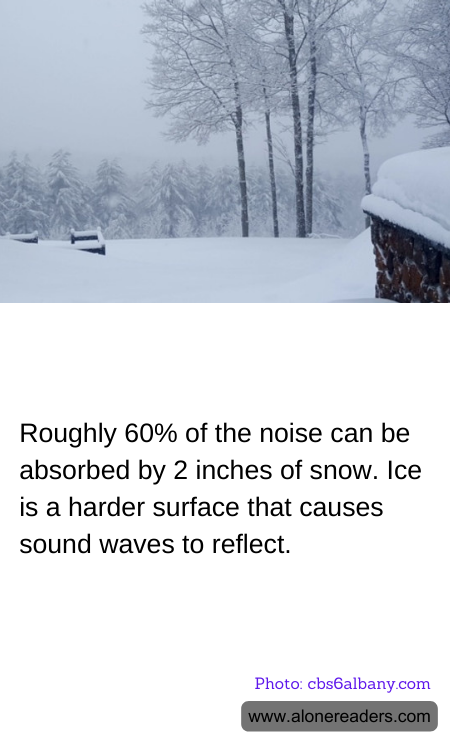
Snow possesses unique acoustic properties that make it an effective natural sound absorber, particularly when compared to ice. One remarkable aspect of snow is its ability to absorb as much as 60% of sound, which is attributed to its porous structure. When snow accumulates, especially to a depth of about 2 inches, it acts as an insulating blanket over surfaces. This absorption occurs because snowflakes, which are made of ice crystals and trapped air, can trap sound waves within their structure. The trapped air and the complex lattice of snowflake structures disrupt the path of the sound waves, causing them to lose energy and diminish in volume.
In contrast, ice presents a harder, more reflective surface than snow. Being more compact and dense, ice does not absorb sound but instead reflects it. This is why environments with surfaces covered in ice can seem louder or produce echoes. Sound waves bounce off the ice and travel with less attenuation compared to snow-covered surfaces, where the sound is muffled and absorbed.
This difference in sound absorption between snow and ice can significantly influence the acoustic environment in colder climates. For instance, after a fresh snowfall, a typical outdoor environment may become unusually quiet, as the fresh snow absorbs the sounds from usual activities. In contrast, areas where snow has melted and refrozen into ice will experience an increase in noise levels due to the reflective properties of ice.
Understanding these properties is crucial not just in everyday observations but also in fields such as environmental science and urban planning, where noise pollution management is essential. Creating environments that take advantage of natural sound absorption can lead to quieter, more serene living spaces, particularly in urban areas where noise is a constant presence. Moreover, this knowledge can enhance winter recreational designs and safety communications by factoring in how sound travels differently across snow and ice-covered landscapes.
