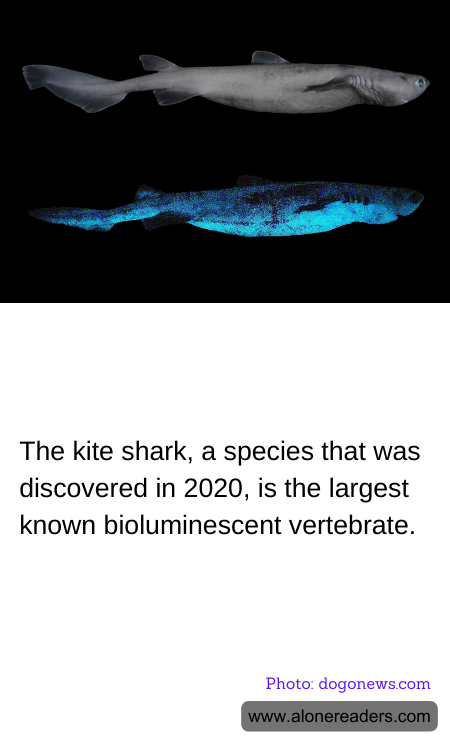
Discovered in 2020, the kite shark marks a remarkable addition to the marine world as the largest known bioluminescent vertebrate. This extraordinary creature inhabits the deep, twilight zone of the ocean, a realm where sunlight barely reaches and bioluminescence - the ability to emit light - becomes a crucial trait for survival. The kite shark utilizes this glowing ability not just to illuminate the dark waters but also as a strategy for predation and communication.
The size of the kite shark is truly impressive, with reports indicating individuals measuring up to 30 feet in length. This size, paired with its bioluminescent capability, distinguishes the kite shark from other marine bioluminescent organisms, which are typically much smaller. The shark’s bioluminescence is emitted through thousands of photophore organs located throughout its body, creating a spectacle of light in the pitch-black depths of its marine habitat.
The discovery of the kite shark has significant implications for our understanding of marine biology and the adaptive mechanisms of deep-sea creatures. Bioluminescence in vertebrates is relatively rare and usually seen in much smaller species. Therefore, studying the kite shark opens new avenues for research on evolutionary biology and the ecological dynamics of the ocean’s deep layers.
Moreover, the existence of such a large biolumorphic vertebrate highlights the vast unexplored territories of our planet’s oceans and reminds us of the continuous discoveries that await. The kite shark's ability to navigate and survive in one of Earth’s most extreme environments using light tells a story of remarkable adaptation. Marine scientists and researchers are especially interested in how this luminescence affects the behavior of other deep-sea organisms, potentially reshaping existing theories about the predatory and social behaviors in this mysterious underwater frontier.
This remarkable species underscores not only the intricacies of evolution but also the importance of ocean conservation. As human activities increasingly impact marine ecosystems, understanding and preserving unique species like the kite Doug provides imperative insights into biodiversity and ecological health far beneath the ocean's surface. The study of such phenomenal creatures is not just about scientific curiosity; it carries important consequences for ecological preservation and the global biodiversity balance.
