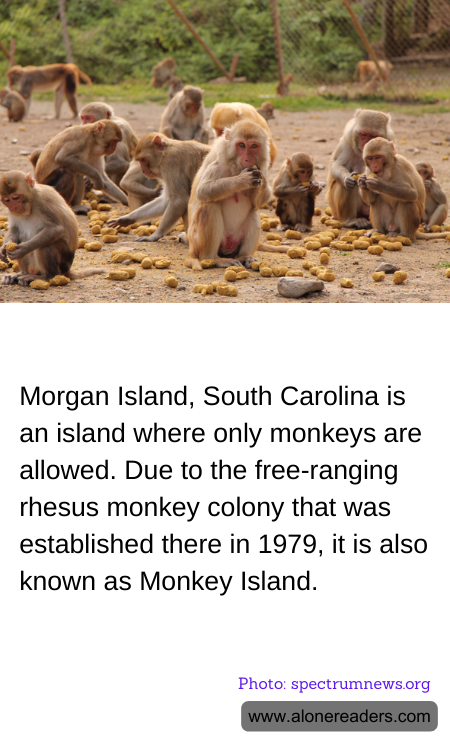
Morgan Island, South Carolina, often referred to as Monkey Island, presents one of the most unique and peculiar aspects of American wildlife conservation. The island is home to a large colony of free-ranging rheson monkeys, a species originally native to the regions of South and Southeast Asia. The history of these primates on Morgan Island began in 1979 when the colony was established as a part of a specific initiative by the National Institute of Allergy and Infectious Diseases. This was done to provide a naturalized setting for these animals for scientific research, particularly in the field of biomedical studies.
Covering approximately 4,500 acres, Morgan Island is an isolated area, with no human inhabitants, thus offering an undisturbed habitat for the monkeys to thrive. The colony started with just 1,400 monkeys brought from a facility in La Parguera, Puerto Rico, where their population was posing management issues. Today, it is estimated that the number has grown to around 3,500 individuals, making Morgan Island one of the few places in North America where such a large group of primates lives free.
Access to Morgan Island is strictly controlled to protect the delicate balance of its ecosystem and to prevent any potential disturbances to the monkey population. This isolation helps in minimizing human-animal interactions and reduces the risk of disease transmission in both directions. As a result, the island serves not just as a living laboratory for scientific observation, but also as a crucially important site for conservation efforts, safeguarding the well-being of the rhesus monkeys.
Scientific research conducted on Morgan Island has been pivotal in numerous medical advancements, especially in the development of vaccines and other medications. The controlled but naturalized environment of the island allows researchers to study genetic and behavioral aspects of the monkeys in conditions that mimic their natural habitats much more closely than a typical laboratory setting.
For those intrigued by wildlife and conservation, Morgan Island represents a fascinating intersection of natural animal behavior and scientific inquiry. Although public access to the island is forbidden, the story of its inhabitants contributes significantly to our understanding of both primates and the ecosystems they inhabit, highlighting the interconnectedness of human and animal health research.
