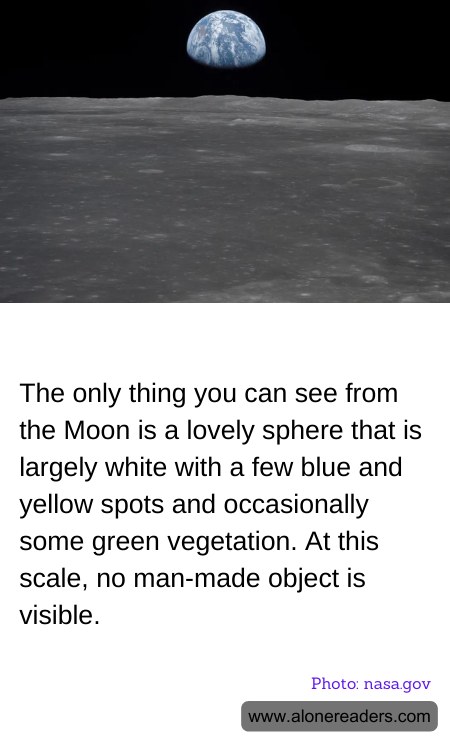
Viewed from the serene expanse of the Moon, Earth presents itself as a breathtaking mosaic of colors and textures, devoid of the visible markers of human civilization. The predominant whites that cover much of its surface are the vast expanses of clouds and polar ice, which reflect sunlight dramatically. These vast, swirling clouds twirl around the planet, driven by the atmospheric forces at play, sometimes obscuring the land and oceans below.
The blues, beautiful and deep, are the oceans that cover approximately 71 percent of the Earth's surface. They function as the planet’s lifeblood, supporting a diverse array of life forms and influencing global weather patterns. The yellow spots that occasionally interrupt these expanses of blue are the arid deserts and dry regions such as the Sahara and the Australian Outback. These arid landscapes, though sparse in vegetation, play a crucial role in Earth's ecological balance, reflecting significant amounts of solar radiation back into the atmosphere.
Occasional splashes of green depict the presence of lush forests and vegetation, indicating areas rich in biodiversity. These patches are crucial as they house an incredible variety of flora and fauna and are essential for the carbon cycle that sustains life by absorbing carbon dioxide and producing oxygen. Despite their importance, these green areas are less prominent from such a distant vantage point, highlighting the vastness of the planet’s aquatic and desert environments compared to land-based ecosystems.
This view from the Moon brings a profound realization of Earth's fragility and the invisibility of human activities from a cosmic perspective. From such a distance, the signs of human life—cities, infrastructure, and machinery—merge seamlessly into the natural landscape, underscoring the notion that despite our significant impact on the planet, we are just a small part of a much larger natural tapestry. This perspective serves as a poignant reminder of the need for humanity to act as responsible stewards of our planet, protecting and preserving it for future generations. The grandeur and beauty of Earth, viewed from its lunar neighbor, accentuates both its vulnerability and the inherent responsibility we share in safeguarding our collective home.
