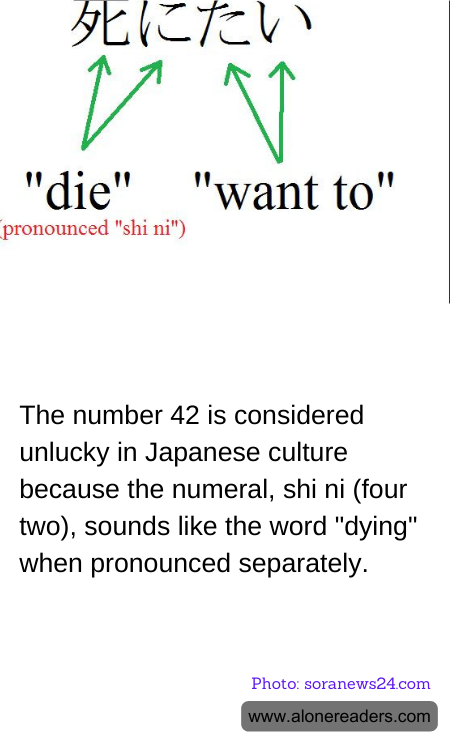
In Japanese culture, which places significant emphasis on the meaning and sound of words, certain numbers are associated with good or bad luck due to their pronunciations. The number 42 is often regarded as unlucky because when its digits are pronounced separately—4 as "shi" and 2 as "ni"—it phonetically resembles the phrase "shi ni," which means "to die" in Japanese. This association is a part of a broader cultural sensitivity to language known as goroawase, which is a form of Japanese wordplay whereby numerical combinations are read in ways that convey particular meanings or words.
This sensitivity to numbers extends beyond 42 and affects various aspects of daily life in Japan. For example, hospitals and hotels frequently avoid using the number 4 in room numbers or floors because "shi" also stands alone as the word for death. Similarly, the number 9, pronounced as "ku," can signify suffering or pain, compounding the aversion to its usage in public settings where well-being and comfort are prioritized.
Despite the superstitions surrounding certain numbers, the Japanese also celebrate numbers with positive associations. For instance, the number 8, pronounced "hachi," suggests growth and prosperity, making it a favored and auspicious number. This dichotomy in the numerological landscape reflects the pervasive influence of numerology across different layers of Japanese culture, impacting everything from personal decisions to business practices.
The perception of the number 42 as unlucky is a reminder of how deeply cultural beliefs and linguistic nuances can be interwoven into everyday life. It highlights the unique way in which language and culture can intersect, influencing perceptions, behavior, and even architectural choices in significant ways. While to outsiders the fear of a number may seem trivial, within the context of Japanese culture, these beliefs are a testament to the complex relationship between language and cultural identity.
