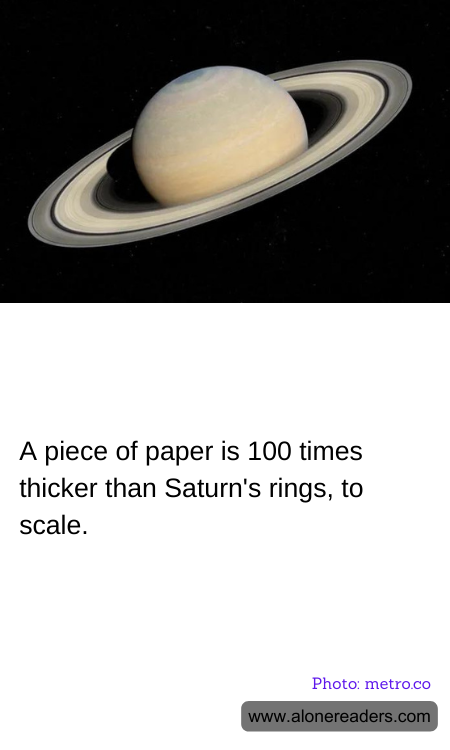
Saturn, the sixth planet from the sun, is distinguished not just by its vast size but also by its spectacular rings, which have fascinated astronomers and sky watchers since Galileo first observed them in 1610. These rings present one of the most striking and beautiful phenomena in our solar system. However, despite their grand appearance, Saturn's rings are remarkably thin when compared to their diameter.
To truly understand the scale of Saturn's rings, consider this surprising fact: if scaled down appropriately, a regular piece of paper, which typically measures about 0.1 millimeters in thickness, is about 100 times thicker than Saturn’s rings. Saturn's rings range from 10 meters to a kilometer in thickness, which, considering their vast extent spreading out up to 282,000 kilometers from the planet, is incredibly slender.
Composed primarily of billions of small chunks of ice and rock, some as tiny as micrometers and others as large as mountains, the rings orbit around Saturn at high speeds. These particles are remnants from comets, asteroids or shattered moons that were torn apart before they could reach the planet, and are kept in place by Saturn’s gravitational pull. The thinness of the rings is due to the orbital mechanics and gravitational forces at play around Saturn, which restrict the vertical movement of the particles and keep them predominantly on a horizontal plane.
This characteristic of Saturn's rings not only illustrates the delicate balance of celestial mechanics but also emphasizes the vast scale of our solar system. Understanding the scale and composition of Saturn's rings helps scientists study the processes that may be similar to those that occurred in the earlier stages of the solar system's formation. This, in turn, provides insights into the formation of other planetary systems, potentially unlocking more mysteries of the universe.
The rings have also shown variations in density and structure, indicating that they are not static but rather dynamic systems that continue to change. Observations from spacecraft like Voyager and Cassini have provided detailed images and data, revealing complex patterns and phenomena such as waves and braids, caused by gravitational interactions with Saturn’s moons.
Thus, while they might seem merely decorative from afar, Saturn's rings are a complex, dynamic system that offers a window into the processes of the cosmos, all the more intriguing because they are, to scale, no thicker than a piece of paper is wide.
