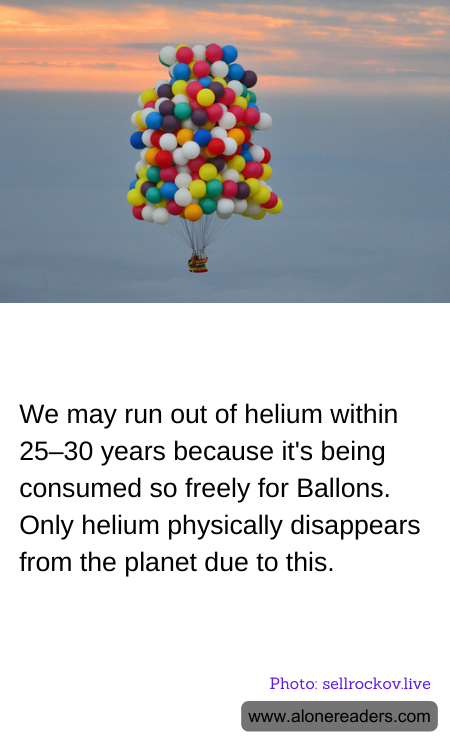
Helium, the second-lightest element and non-renewable resource, is a fundamental component used in various scientific, medical, and technological applications, ranging from MRI machines to space exploration. Interestingly, this inert gas is primarily obtained from natural gas fields where it has accumulated over millions of years through radioactive decay. However, a significant and more visible consumption of helium is for inflating balloons, primarily for entertainment and decorative purposes.
The concern about helium depletion lies in its unique properties and irreplaceability in certain critical applications. Unlike other elements or resources, helium, once released into the atmosphere, eventually escapes into space. This is due to its extremely low atomic mass, which allows it to reach escape velocity and leave the Earth's gravitational field. Hence, when helium is used in balloons and eventually released, it is permanently lost to our planet.
There are predictions suggesting that at the current rate of consumption, the world might run out of economically viable helium reserves within the next 25 to 30 years. This scenario is alarming, considering the critical roles helium plays, particularly in the fields of healthcare and scientific research. For example, helium is essential in maintaining the supercool temperatures required for MRI scanners to function effectively. It is also used in the Large Hadron Collider, fiber optics, and in the cooling of nuclear reactors.
The prospect of a helium shortage urges a reconsideration of our usage priorities. The recreational use in balloons, while culturally significant in celebrations, poses an ethical dilemma about resource allocation. Several scientists and industry experts advocate for stricter regulations on helium use, prioritizing essential services over entertainment. Some countries and entities have already begun to implement policies to manage and conserve helium more effectively. For instance, the U.S. Federal Helium Program, managed by the Bureau of Land Management, oversees the extraction and sale of helium from the Federal Helium Reserve, primarily aiming at conservation and strategic reserve maintenance.
The idea isn't to eliminate the joy and aesthetics provided by helium balloons but to develop awareness and perhaps seek alternatives that can reduce helium consumption. With advancements in materials science, there are opportunities to create balloon-like products that do not require helium and are environmentally friendly. Public awareness and education about helium's critical uses and the implications of its shortage could also drive changes in consumer behavior, thereby conserving this scarce resource for its indispensable uses. As we move forward, balancing conservation with technological innovation will be crucial in managing helium resources, ensuring they remain available for the vital applications on which modern society depends.
