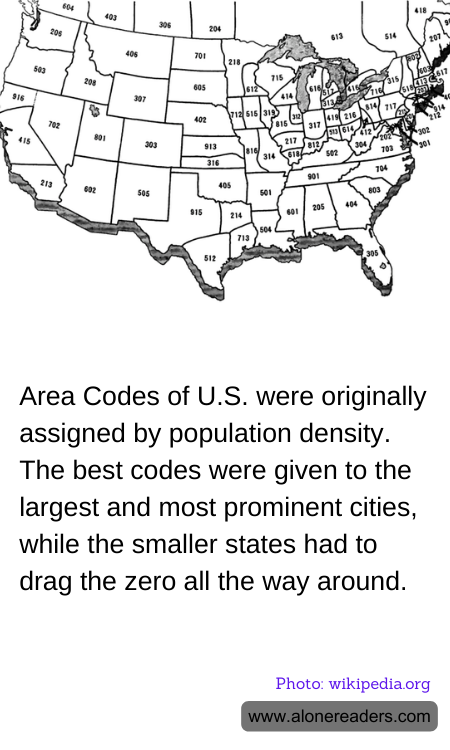
When the North American Numbering Plan (NANP) was introduced in 1947 to standardize telephone dialing formats, area codes were assigned across the United States and Canada based on a strategic design that capitalized on the technology of the rotary dial telephone. At this time, each area code had a middle digit of either '0' or '1', with '0' indicating a whole state or region and '1' used for states that required multiple area codes due to higher populations.
The allocation of specific codes was done not randomly, but with an eye toward efficiency. Areas with higher population densities and consequently higher telephone traffic were assigned area codes that minimized the time and effort required to dial them on a rotary phone. Therefore, major cities such as New York (212), Los Angeles (213), and Chicago (312) received area codes that were quicker to dial. The fewer the rotations of the dial, the faster the number could be dialed, which was an essential consideration given the mechanical nature of rotary technology.
In contrast, less populated states or areas received codes that involved more dial pulls, such as 907 for Alaska, 401 for Rhode Island, and 402 for Nebraska. This meant that users in less populated areas spent more time dialing each digit of an area code. The notion behind this distribution was not just based on convenience but also technological limitations and the cost associated with expanding telephone infrastructure.
As telephone technology evolved and the rotary phones were replaced by touch-tone phones with buttons, the physical effort of dialing decreased and the original reasoning behind the pattern of area code assignments became obsolete. This technology shift led to the introduction of a broader array of area codes, including those that did not adhere to the original 'N0/N1' format.
Today, with the proliferation of digital dialing and mobile technology, the original considerations for area code assignments based on population density and dialing ease have largely disappeared. Modern area code allocation is more likely to be influenced by other factors such as the availability of numbers and the geographic distribution of telephone service providers.
Despite these advances, the historical impact of the original area code system still influences dialing patterns and cultural references. The ease of dialing a number like 212 continues to carry a cachet that newer area codes do not, reflecting a time when dialing a few less numbers meant a connection not just to a place, but to a dense, important hub of activity—a concept that reverberates through history, influencing perceptions and values in telecommunication.
