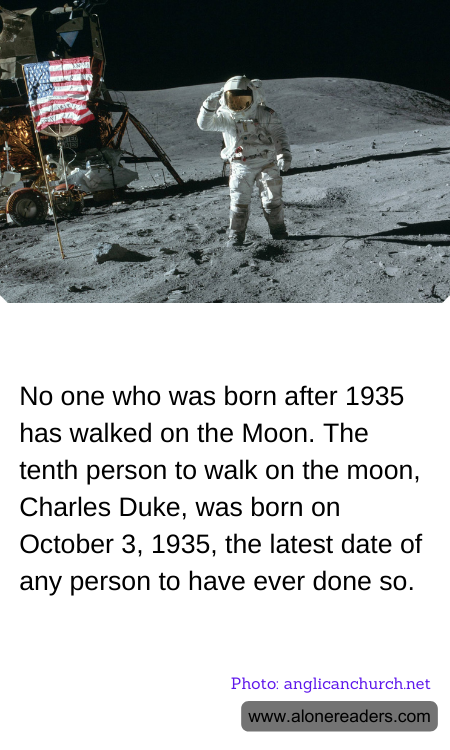
The exploration of space, particularly the Moon, has long captured human imagination and ambition. One of the most striking facts about the moonwalkers is that no one born after 1935 has ever set foot on the lunar surface. This signifies not just a generational gap but also highlights the historical context in which these missions took place. Charles Duke, an astronaut with the United States Apollo program, holds the distinction of being the youngest person to walk on the Moon, and the last born (on October 3, 1935) to have achieved this feat. His journey to the Moon during the Apollo 16 mission marked him as the tenth person to walk on the lunar surface.
This fact underlines a broader narrative about the era in which these astronauts were born and trained. The majority of the astronauts involved in the Apollo missions, which resulted in human footprints on the Moon, were products of the early to mid-20th century. Their formative years were influenced by significant global events such as World War II and the ensuing Cold War. The urgency driven by political and technological rivalry during the Cold War, particularly between the United States and the Soviet Union, precipitated a fervent period of space exploration. NASA’s Apollo program, culminating in Neil Armstrong and Buzz Aldrin’s historic moonwalk in 1969, was both a scientific endeavor and a political statement.
The fact that no one born after 1935 has walked on the Moon speaks to various factors, including shifts in policy and funding for space exploration. After the initial series of manned lunar landings, priorities shifted towards other aspects of space exploration, such as the Space Shuttle program, the International Space Station, and unmanned exploratory missions to other planets. It also mirrors changing political climates and public interests. Currently, as we advance further into the 21st century, there is renewed interest in returning humans to the Moon and even missions to Mars are being planned. The Artemis program, led by NASA with international and commercial partners, aims to return humans to the Moon, targeting the inclusion of the first woman and the next man on the lunar surface, possibly extending the birthdates of moonwalkers beyond 1935.
The layers of history, technology, and geopolitics embedded in the narrative of lunar exploration encapsulate more than just technical achievements; they reflect humanity's relentless pursuit to push the boundaries of what is possible. As new generations look up at the Moon, the stories of astronauts like Charles Duke not only serve as reminders of past glories but also as inspiration for future possibilities.
