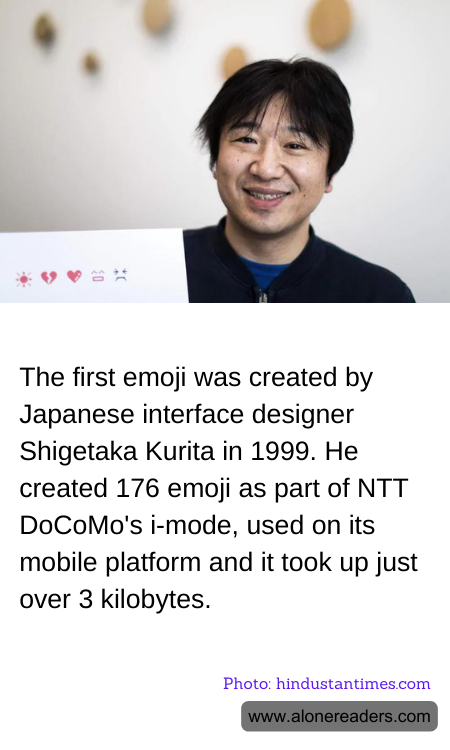
In the late 1990s, the advent of mobile technology brought many innovations, one of which was the creation of the first emoji by Shigetaka Kurita. In 1999, Kurita, a Japanese interface designer, developed 176 emoji for NTT DoCoMo's i-mode, a mobile internet platform popular in Japan. At the time, these emoji were a groundbreaking way to convey information succinctly and effectively in a digital form. Despite their simplicity, these tiny pictures carried a significant amount of emotional and practical information, allowing users to express feelings, ideas, and messages in a visually engaging way.
The initial set of emoji created by Kurita was designed to be straightforward yet comprehensive, covering various symbols from weather conditions to traffic signs, and emotional expressions. This was a revolutionary development in the field of communication, as it addressed the challenges of space constraints and the increasing need for rapid information transmission in mobile communication. Each emoji occupied just over 3 kilobytes, which was a minimal amount of data given the technological limitations of that time.
The concept of using pictures to communicate wasn't entirely new—humans have been using images to represent ideas and words for centuries. However, the integration of emoji into mobile communication represented a novel integration of visual language and electronic text. Over time, these initial designs would evolve and be adopted globally, becoming a fundamental aspect of digital communication across various platforms.
Today, emoji are an integral part of online and text messaging communication, transcending linguistic barriers and enhancing the way people connect over digital spaces. They add nuance to text, serve as prompts for reaction, and even convey messages on their own. The design and usage of emoji have expanded dramatically, influenced by changes in society, culture, and technology. From simple smiley faces to an extensive array of symbols that depict everyday objects, various human activities, and diverse cultural phenomena, emoji have become a universal language of the digital age. This evolution from Kurita's initial set to today's wide array reflects broader cultural shifts and technological advancements, highlighting the dynamic nature of digital communication.
