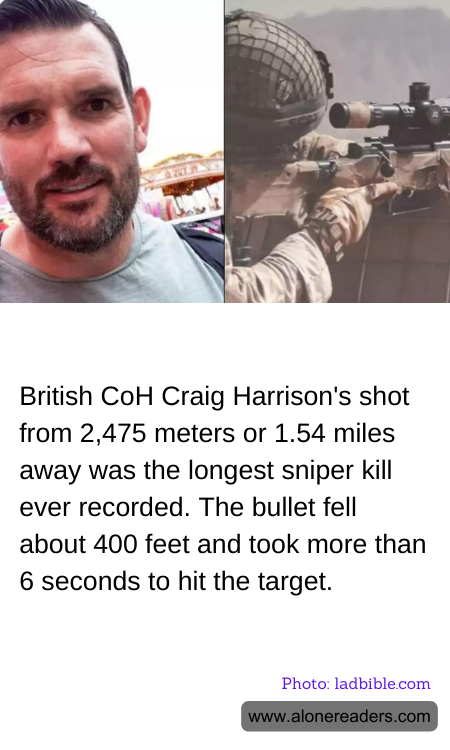
The remarkable story of British Corporal of Horse (CoH) Craig Harrison redefined the capabilities of military snipers and showcased exceptional skill and precision. The sniper's shot, which he tactfully executed in November 2009 during the Afghanistan conflict, holds the record for the longest confirmed sniper kill in military history. Harrison achieved this extraordinary feat while stationed with the Household Cavalry in Helmand Province, an area known for intense military engagements.
His record-setting shot was measured at an astonishing distance of 2,475 meters, or approximately 1.54 miles, surpassing the previous record held by Canadian sniper Rob Furlong. This achievement was made using the L115A3 Long Range Rifle, a .338 Lapua Magnum, known for its tremendous range and penetrating capabilities. The environmental factors that Harrison had to consider exert the level of complexity involved; not only did he have to consider the great distance, but also adjust for wind speed, air density, and the Coriolis effect—the influence of the Earth's rotation on the bullet's trajectory.
Remarkably, the ammunition used fell approximately 400 feet from its release height by the time it hit the target and took over 6 seconds to reach its destination. This delay and substantial drop highlight the gravitational and temporal challenges faced in long-range sniper engagements. The precision of Harrison's shot under such extreme conditions signifies an extraordinary level of expertise and highlights the critical importance of mathematics, ballistics understanding, and environmental awareness in sniper operations.
Harrison's sniper shot not only set a world record but also demonstrated the evolving capabilities and tactical sophistication of modern military forces. It underscore The sniper’s role on the battlefield has evolved exponentially, turning sniper operations into a combination of science, art, and raw skill. This historic shot by CoH Craig Harrison stands as a testament to what training, innovation, and sheer determination can achieve under the most challenging conditions.
