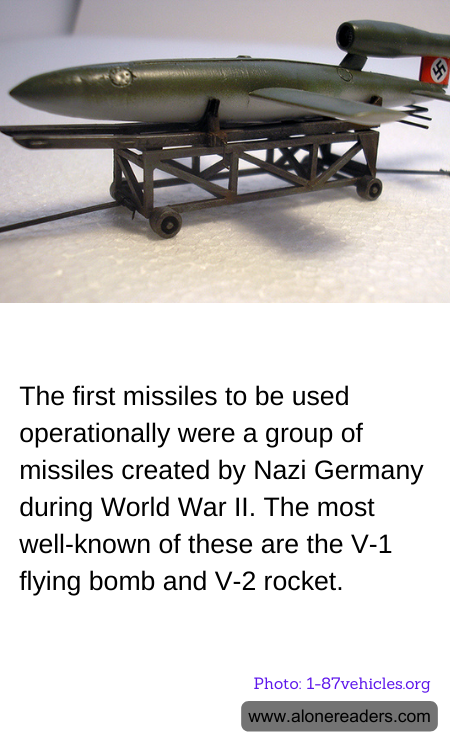
During World War II, Nazi Germany pioneered the operational use of missile technology, marking a significant advancement in warfare tactics. Among these early missiles, the V-1 flying bomb and the V-2 rocket stand out for their historical impact and technological complexity.
The V-1 was the first of these weapons to be introduced, known commonly as the "buzz bomb" or "doodlebug" because of its distinctive buzzing sound. Developed as a vengeance weapon for terrorizing the British civilian population, the V-1 was essentially an early cruise missile powered by a simple jet engine. Launched from sites in occupied Europe, thousands of these were fired towards London and southern England in 1944 and 1945. Despite their psychological impact, the inaccuracy of the V-1 meant its effectiveness as a strategic weapon was limited.
More sophisticated and ominous was the V-2 rocket, the world's first long-range guided ballistic missile. The development of the V-2 was a significant technological leap, using a liquid-propellant rocket engine that allowed it to deliver a warhead over a considerable distance with unprecedented speed. Unlike the V-1, the V-2’s approach was supersonic at a speed faster than the speed of sound, giving no advance warning before impact and rendering defense measures largely ineffective. From 1944, V-2 rockets were launched against Allied cities including London, Antwerp, and Liège, causing devastating effects.
The technological concepts demonstrated by the V-1 and V-2 missiles during World War II laid foundational principles for post-war rocket development in both military and civilian contexts. Post-war, both the United States and the Soviet Union captured the technology and expertise behind these missiles through Operation Paperclip and its Soviet counterpart, integrating Nazi innovations into their own missile programs. This not only led to the development of advanced military weaponry during the Cold War but also contributed to the international space race, culminating in achievements such as the moon landings.
The legacy of these early missiles is a testament to the dual-use nature of technology, where innovations designed for destruction also have the potential to foster unprecedented advancements in peaceful endeav-indexers such as space exploration.
