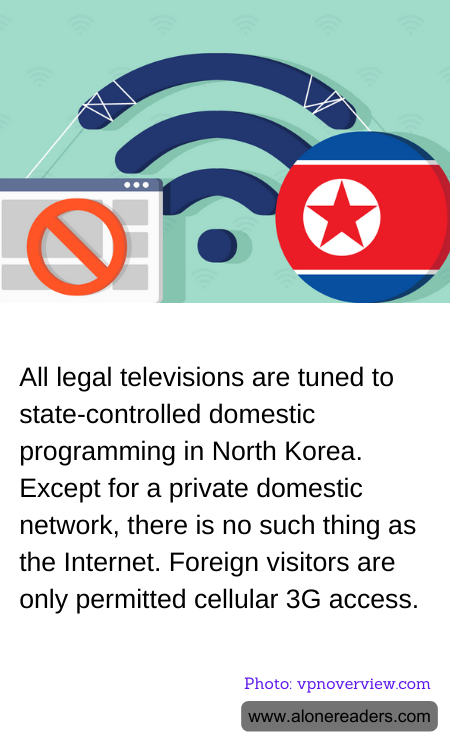
In North Korea, the media landscape is tightly controlled by the government, with all legal television sets programmed to receive only state-controlled domestic broadcasts. This approach ensures that the content viewed by the public aligns strictly with the government's agenda, promoting propaganda and ensuring a uniformity in the information that is disseminated across the population. The media serves as a tool for indoctrination and the reinforcement of the regime's ideologies and policies.
Apart from television, the concept of the Internet as known globally is virtually non-existent in North Korea. The general public does not have access to the global Internet but is instead limited to a domestic version known as Kwangmyong. This network is a state-sanitized version of the Internet, providing content that is heavily monitored and controlled. It includes a limited selection of pre-approved websites and services, all of which reinforce state ideologies.
For foreign visitors, the restrictions are slightly relaxed. They are permitted to access cellular 3G networks, which allows them some level of connectivity to the outside world. However, this access is closely monitored, and the content remains heavily censored by North Korean standards. The availability of 3G access does not extend to the North Korean populace, who are kept isolated from global communication networks, effectively limiting their perspective of the outside world and keeping them under the informational control of the state.
These policies reflect the North Korean government's overarching strategy to control its image, both domestically and internationally, and to maintain a strict grip on the flow of information. The lack of access to global perspectives ensures that dissenting views cannot easily permeate the societal fabric, thus stabilizing the regime's power. By controlling communication channels, the state can maneuver its narrative without contradiction, maintaining an environment where government propaganda flourishes unchallenged.
