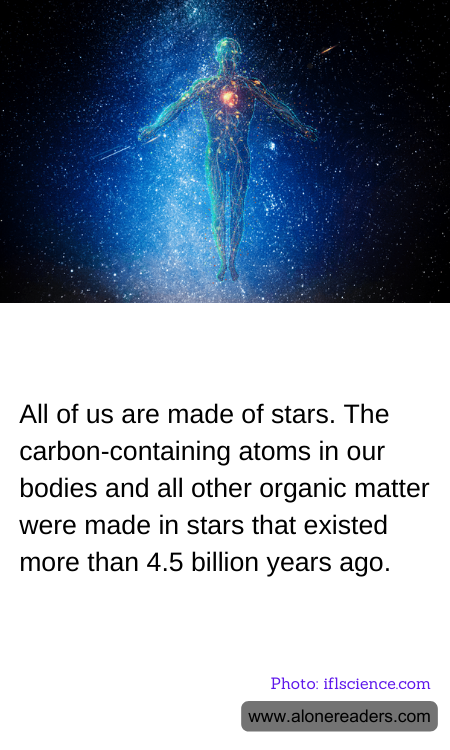
"All of us are made of stars" is not just a poetic statement but a scientific fact that highlights the intimate and profound connection between the cosmos and every living being on Earth. The elements that constitute our bodies, such as carbon, nitrogen, and oxygen, have their origins in the nuclear furnaces of stars that existed long before our solar system was formed.
Stars generate energy and heavier elements through nuclear fusion, a process where lighter elements such as hydrogen and helium merge under extreme pressure and heat to form heavier ones. During their lifecycles, particularly in their later stages, stars can explode in supernovae, spectacular and violent events that are crucial for dispersing these newly formed elements across the universe. These elements are then incorporated into new star systems and planets, including Earth.
Approximately 4.5 billion years ago, our solar system began to coalesce from a cloud of gas and dust rich in these stardust elements. As the Earth formed and evolved, these elements combined to form minerals, water, and eventually, organic molecules. The carbon that forms the backbone of all organic chemistry on Earth was once part of ancient stars, underscoring the stellar origins of all life forms on our planet.
Understanding that every atom within us was once part of a star fosters a deeper appreciation of our place in the universe and can impact our perspective on life and our environment. This cosmic connection ties each of us to the universe's broader narrative of complexity and continuity, offering both a humbling and inspiring reflection on our origins and our ultimate interconnectedness with the cosmos.
