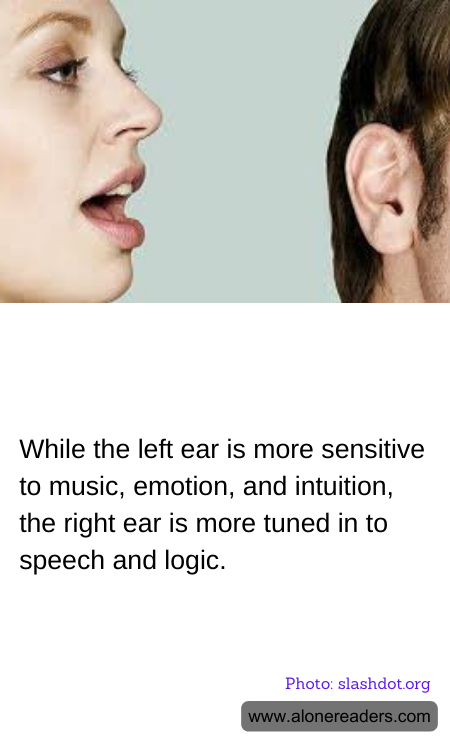
The human auditory system is a complex and finely tuned mechanism that not only allows us to perceive sounds but also processes them in a way that is intricately linked with our cognitive functions and emotional processing. Intriguingly, research suggests that our ears may have different roles in how we interpret sounds, with the left ear generally being more sensitive to music, emotions, and intuitive aspects of auditory information, while the right ear is more attuned to speech, logic, and systematic details.
This specialization is rooted in the brain’s hemispheric dominance theory, where each hemisphere of the brain tends to specialize in and process different types of cognitive tasks. The left hemisphere, which controls the right side of the body, is often associated with logical reasoning, language processing, and analytical tasks. Conversely, the right hemisphere, controlling the left side, is linked more with creativity, emotion, and intuition. Due to the brain’s cross-connections, where each hemisphere primarily receives sensory input from the opposite side of the body, the ears also exhibit a similar pattern of specialization.
Studies have shown that this lateralization can affect how effectively we process information from our environment. For example, when people are asked to listen to music, their left ear, which is connected to the right hemisphere of the brain, may have a more pronounced response, particularly to the music’s emotional content. Musicians have been found to have more acute sensitivity in their left ear for aspects of melody and harmony, an advantage likely enhanced by their training and practice.
Similarly, in language processing tasks, the right ear has shown a distinct advantage. This is particularly evident in challenging listening environments where speech sounds need to be rapidly processed. The left hemisphere’s prowess in handling linguistic and logical tasks makes the right ear more efficient at decoding and understanding speech in real-time.
Furthermore, this ear asymmetry extends to emotional vocalizations and nuances in spoken language that convey different sentiments and attitudes. Emotional coloring in language, like irony or sarcasm, and subtle changes in emotional tone, are better perceived by the left ear, according to some auditory perception studies.
In understanding these auditory distinctions, there's potential for practical applications, such as in educational settings where optimizing auditory input channels could aid learning, or in clinical scenarios where this knowledge might influence rehabilitation strategies for those with hearing or processing impairments. Moreover, acknowledging and harnessing these hemispheric and auditory strengths might help individuals better understand their own perceptive and cognitive biases, tailoring their activities and environments accordingly for maximum productivity and emotional well-being.
