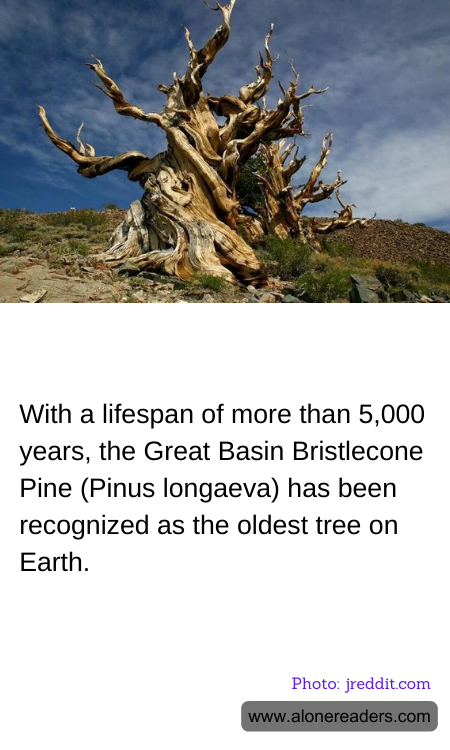
The Great Basin Bristlecone Pine (Pinus longaeva) truly stands as a marvel of nature, showcasing not just the beauty of the natural world but also its incredible resilience. These ancient trees, holding the title for the longest-lived non-clonal organisms known to science, can live for more than 5,000 years, with the oldest among them, named Methuselah, estimated to be over 4,800 years old. This remarkable age makes the Bristlecone Pine the oldest known individual tree in the world.
Found primarily in the United States, these trees are native to the arid mountain ranges of California, Nevada, and Utah. The harsh conditions at high altitudes, ranging from 5,600 to 11,200 feet, contribute significantly to their longevity. The cold, dry climate inhibits the spread of diseases and reduces the decay rate of their wood, and their twisted and gnarled forms bear witness to the fierce winds and punishing temperatures they endure. Despite the challenging conditions, or perhaps because of them, Bristlecone Pines have perfected the art of survival.
Astonishingly, their growth rings provide records of ecological change spanning thousands of years, offering invaluable information to scientists. By analyzing these growth rings, researchers can construct a detailed history of the local climate, gaining insights into patterns of rainfall and temperature over millennia. This information is particularly valuable in the study of climate change and environmental shifts, as it provides a long-term background against which recent changes can be measured.
Moreover, their unique genetic makeup allows these trees to survive in such inhospitable environments. Studying the adaptations that enable the Bristlecone Pine to live so long can also give scientists clues about how trees and other plants might cope with the increasingly extreme conditions brought by climate change. Indeed, the implications for biodiversity conservation are significant, suggesting ways in which other species might be made more resilient to environmental stresses.
In contemporary times, these ancient trees face new challenges, including the impacts of human activity and global warming. While they are protected under the umbrella of national parks like the Great Basin National Park in Nevada, ensuring these ancient sentinels can withstand new pressures is an ongoing effort. Preservation and study of Bristlecone Pines not only help protect these fascinating trees but also bolster scientific understanding of longevity, resilience, and environmental history, providing lessons that are crucial for the conservation of diverse ecosystems worldwide.
In summary, the Great Basin Bristone Pine stands not only as a record-holder by age but as a testament to the perseverance of life under the most stringent conditions. Their existence challenges the commonly held views on the limitations of longevity, offering hope and insights into the sustainable coexistence of humanity with the natural world. Through them, we gain a deepened respect for nature's complexity and an enhanced commitment to preserving it.
