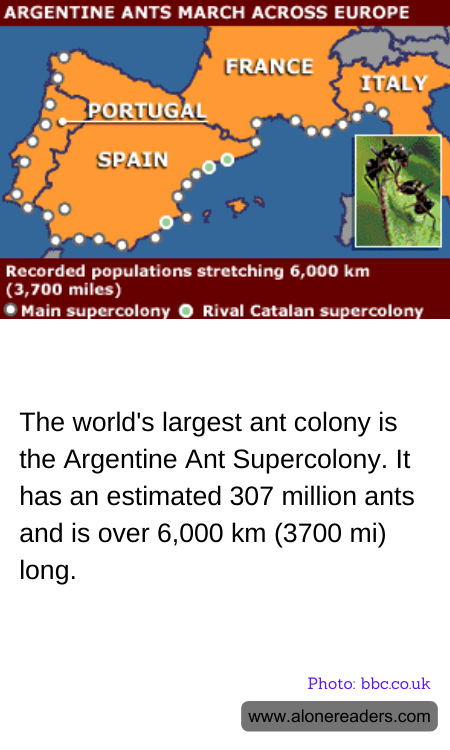
The Argentine Ant Supercolony, recognized as the largest ant colony in the world, represents a fascinating example of biological success and adaptability. Spanning an astonishing 6,000 kilometers across, the supercolony stretches along coastal regions linking Italy, Spain, and France, and has also established populations in other parts of the world including California and Japan. This remarkable extension is inhabited by approximately 307 million ants, uniquely interconnected and cooperative across vast distances.
Originating from the borders of Paraguay, Argentina, and Brazil, the Argentine ant (Linepithema humile) has been extraordinarily successful in invading and establishing colonies in various temperate regions around the world. Their incredible spread is largely attributed to their aggressive colonization strategies and highly cooperative nature. Each individual colony typically functions as part of a bigger supercolony, maintaining a peaceful existence with genetically similar neighbors while showing aggression towards genetically different Argentine ant colonies.
The success of such a supercolony presents both ecological concerns and scientific interests. On one hand, the sheer scale and dominance of the Argentine Ant Supercolony disrupt local ecosystems. Their aggressive expansion displaces native ant species, thereby altering the ecological balance and potentially leading to a reduction in the diversity of local flora and fauna. This ant species is often characterized by its high adaptability to various environments and its ability to exploit resources, which further enhances its invasive character.
From a scientific perspective, the supercolony offers valuable insights into the communication, behavior, and social structure of ants. Researchers have studied how these ants manage to maintain unity and avoid conflict across such vast territories, particularly focusing on their chemical communication mechanisms. The chemistry of their pheromones plays a crucial role in their social interactions, helping them identify members of their own colony and facilitating cooperative behaviors.
In conclusion, while the Argentine Ant Supercolony showcases the incredible capabilities of these small but formidable insects to adapt, cooperate, and thrive, it also highlights the potential ecological repercussions of their invasive nature. As scientists continue to study this phenomenon, understanding the balance between admiration for their achievements and concern for native biodiversity remains a significant challenge.
