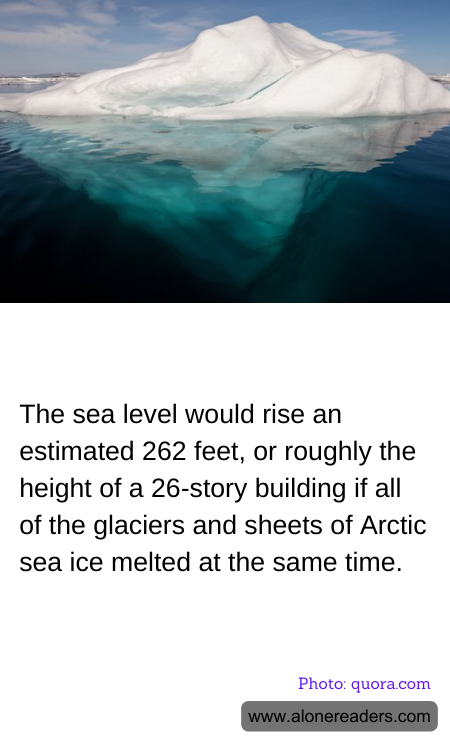
Imagine a world where all the glaciers and the vast sheets of Arctic sea ice melted simultaneously. Such a scenario would result in an immense rise in sea levels globally—by an estimated 262 feet, or roughly the height of a 26-story building. This dramatic increase would reshape coastlines around the world, submerge major cities, and disrupt ecosystems and weather patterns on a scale never seen before by humanity.
Currently, glaciers and ice sheets hold the vast majority of the Earth's freshwater reserves. They act as natural reservoirs slowly releasing water into the ocean. However, as global temperatures rise due to climate change, the rate at which this ice melts has accelerated. While it’s highly unlikely that all of this ice would melt at once, even the gradual melting poses significant risks.
If sea levels were to rise by 262 feet, the geographic and economic impacts would be catastrophic. Coastal cities and islands, which house large populations and critical infrastructure, would be the hardest hit. Cities like New York, Miami, and New Orleans in the United States, as well as international cities like Amsterdam, Bangkok, and Jakarta, could face severe flooding disasters or be submerged completely, leading to unparalleled economic losses and human displacement.
Furthermore, the disappearance of Arctic ice would also spell disaster for marine wildlife. The ice provides habitat and hunting grounds for several species such as polar bears and seals. Additionally, the increase in global sea levels could lead to saltwater intrusion into freshwater resources, contaminating drinking water supplies and agricultural lands, which could lead to food shortages and public health crises.
Addressing this potential threat involves global cooperation to mitigate climate change, predominantly by reducing greenhouse gas emissions and moving towards sustainable, renewable sources of energy. Technology and innovation play pivotal roles in monitoring glacier and sea ice melt, and in developing adaptive strategies that can be implemented in vulnerable regions. Public awareness and scientific outreach are also critical to fostering a collective will to tackle these environmental challenges head-on.
In conclusion, while the complete melting of all glaciers and Arctic sea ice is an extreme scenario, it underscores the urgent need for climate action. The potential rise in sea levels is a warning of the irreversible impacts of global warming, emphasizing the need for immediate and concerted efforts to preserve our planet’s future.
