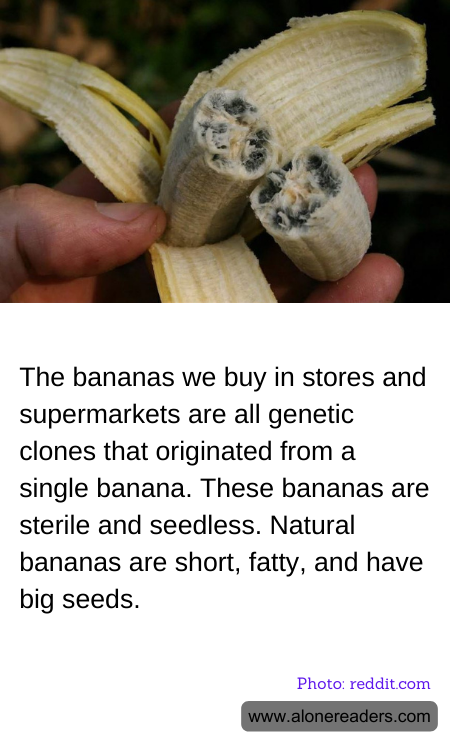
Bananas, as we commonly purchase them from grocery stores, are quite different from their wild ancestors. The typical supermarket banana, specifically the Cavendish variety, is a product of specific agricultural breeding and is indeed essentially a clone. All the Cavendish bananas are genetically identical, derived from one original source banana through a process called vegetative propagation. This method bypasses sexual reproduction to create genetically uniform lineages, which means every single Cavendish banana is a replica of another.
This cloning factor is significant because it implies that these bananas are sterile and do not contain seeds, making them more convenient for consumption. In contrast, natural, wild bananas are typically shorter, fatter, and packed with large seeds. These seeds are a fundamental part of the fruit's reproduction process but make them less appealing and harder to eat than the seedless commercial varieties.
The backstory of how we came to have the Cavendish banana as a dominant market variety involves its predecessor, the Gros Michel, which was similarly a clone variety used by commercial growers. The Gros Michel was almost wiped out in the mid-20th century due to Panama disease, a type of fungal infection that attacks banana plants. Cavendish was then selected because it was resistant to the strains of the fungus that had decimated the Gros Michel.
However, relying on a single clone variety for global distribution has its risks. The lack of genetic diversity means that if a disease or pest learns how to attack one plant, potentially all plants of that variety worldwide are at risk. This is currently a concern with the Cavendish bananas, as newer strains of Panama disease are starting to affect them too.
In evolutionary terms, the fact that commercial bananas are clones and thus all genetically identical is a double-edged sword. While it provides consistency and reliability in production and supply, it also exposes the crop to potential widespread disaster from pests or diseases. This paradox encapsulates the challenges faced in modern agricultural production, balancing productivity and sustainability against the backdrop of global change.
