More About This Card
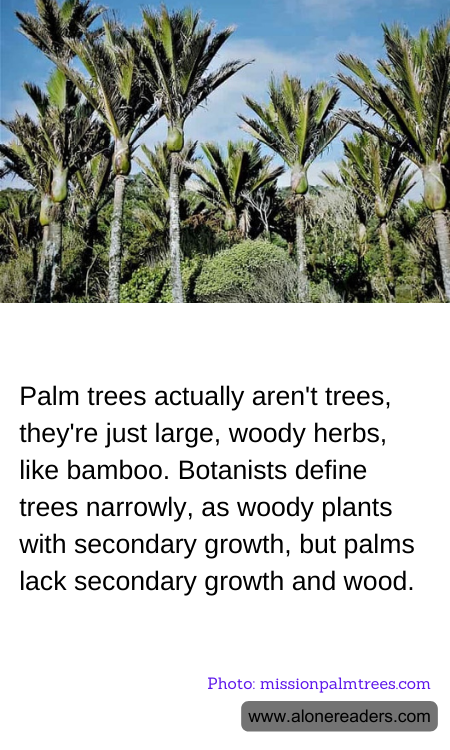
Palm trees, ubiquitous symbols of tropical beaches and sunny climates, have long been classified in the popular imagination as trees. However, from a botanical perspective, palms are not true trees. In the world of plant biology, a tree is defined as a perennial plant with an elongated stem, or trunk, supporting branches and leaves, and most critically, having secondary growth. Secondary growth refers to the ability of a plant to increase its girth through the development of wood and bark, which is facilitated by the vascular cambium—a layer of tissue that produces new cells internally and externally.
Palms, on the other hand, do not have this secondary growth. Rather than developing a network of branches and wooden tissues as a tree does, palms grow from a single growth point at the top of their trunk, continuously producing leaves and shedding the older ones that die. This growth pattern is more similar to that of large, woody herbs or grasses like bamboo. The trunk of a palm is essentially a hardened, upright stem that expands only from the top as new material is laid down, much like how grass grows, albeit on a significantly larger scale.
Moreover, the internal structure of a palm is quite different from that of true trees. The trunk of a palm is made up of spongy, fibrous material that is often dense and packed tightly to provide stability and support, allowing it to grow quite tall. However, it lacks the complex arrangement of water-conducting xylem and nutrient-conducting phloem that is characteristic of the wood in trees. This structure provides palms with a unique set of mechanical properties that differ from those of trees—most notably, a flexibility that allows them to bend but not break under the pressure of strong winds, such as those experienced during tropical storms or hurricanes.
Understanding that palms are not "trees" in the strict botanical sense but large, woody herbs changes our perception of these iconic plants. It highlights the incredible diversity of the plant kingdom and the variety of evolutionary paths different groups of plants have taken to adapt to their environments. This knowledge not only enriches our understanding of nature but also underscores the importance of precise scientific language in accurately describing and classifying the world around us.