More About This Card
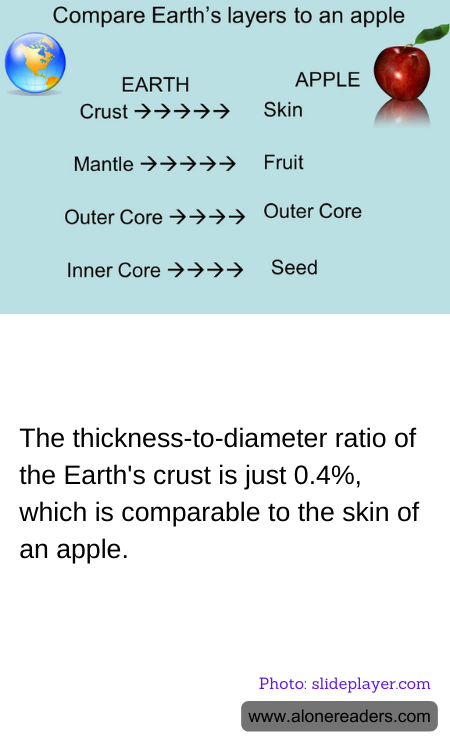
The Earth, a complex and dynamic system, consists of several layers, each with unique characteristics and functions. One of these layers, the Earth's crust, is remarkably thin when compared to the entire planet, much like the skin on an apple. To put it into perspective, the thickness-to-diameter ratio of the Earth's crust is merely about 0.4%. This comparison is not just a poetic metaphor but a real illustration of how incredibly thin the crust is relative to the size of the whole Earth.
The Earth's crust itself is divided into two distinct types: the continental crust, which makes up the continents and the oceanic crust, which forms the ocean floors. The continental crust is thicker, averaging about 30-50 kilometers, but can extend up to 70 kilometers in some places like mountain ranges. In contrast, the oceanic crust is thinner, generally about 5-10 kilometers thick. Despite these variations, when averaged and compared to Earth's total diameter—approximately 12,742 kilometers—the crust still remains just a thin shell.
This thin layer is all that stands between life on Earth and the molten rock of the mantle below, consisting primarily of silicate rocks which are rich in minerals such as quartz and feldspar. Despite its thinness, the crust is crucial. It is the Earth's crust that supports all terrestrial life forms, as well as the oceans, and is where all human activities are based. It contains all the natural resources, like metals and fossil fuels, which are indispensable for modern civilization.
The fact that the Earth's crust is only as thick in comparison to its diameter as the skin of an apple emphasizes the fragility of this layer. It is susceptible to natural phenomena such as earthquakes, volcanic activity, and erosion—processes that are driven by the dynamic nature of the planet's interior and the movement of the Earth’s tectonic plates. These tectonic movements can create powerful shifts even though the crust itself is so thin, evidencing the immense energy and forces at work beneath our feet.
Moreover, this comparison highlights the significance of taking care of this thin layer. Human activities such as mining, deforestation, and pollution can have profound impacts on its stability and health. Understanding the thinness of the crust encourages a greater appreciation of its importance and a call to action for its preservation. Ensuring the health of the crust is not just about protecting a thin layer of Earth; it is about safeguarding the future of all life that depends on its integrity.