More About This Card
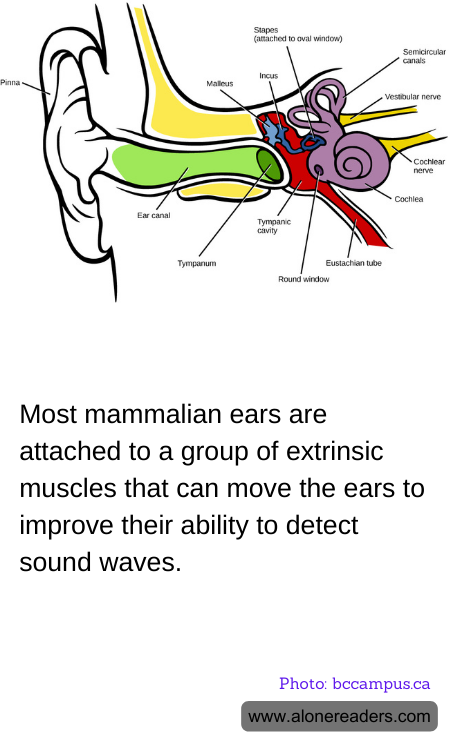
Mammals exhibit a remarkable variety of adaptations that enhance their survival and interaction with the environment, with the auditory system being a prime example. Many mammals have ears that are not only capable of detecting sound but are also physically adept at enhancing this sensory function through movements facilitated by extrinsic muscles. These muscles are responsible for the mobility of the ears, allowing them to swivel, tilt, or rotate towards the source of a sound.
This ability to move the ears independently of the head is especially pronounced in species like cats, dogs, and horses. For these animals, auditory acuity is essential for communication, hunting, and evasion of predators. The extrinsic muscles, attached to the base of the ear, can position the ear to capture more sound waves, which are funneled into the ear canal, striking the eardrum and creating vibrations that are transmitted to the inner ear. Here, the vibrations are converted into electrical signals and sent to the brain, which interprets them as sounds.
The functionality of these ear movements varies from one species to another. Predatory mammals, for example, use their mobile ears extensively to locate prey. A cat might rotate its ears to pinpoint the rustling of leaves that could indicate the presence of a mouse. Similarly, deer and other prey animals use their highly mobile ears to catch sounds that might signify the approach of predators.
Interestingly, some mammals have developed even more sophisticated methods to enhance their hearing. Bats, for instance, use echolocation to navigate and find food in the dark. Their ears are specially adapted to capture echoes of the sounds they emit, bouncing off objects in their environment.
This capacity to move the ears is less developed in primates, including humans. While humans and other primates have some minor musculature around the ears, these are generally not capable of the fine and controlled movements seen in many other mammals. This difference underscores a key point in evolutionary biology: the form and function of organisms are deeply influenced by their ecological niches and evolutionary history.
Understanding how these extrinsic muscles in mammalian ears function not only sheds light on the sensory world of these animals but also highlights the complexity and diversity of evolutionary adaptations. The ears, though small and often overlooked, play a critical role in the survival of many species through their sophisticated and responsive adaptations.