More About This Card
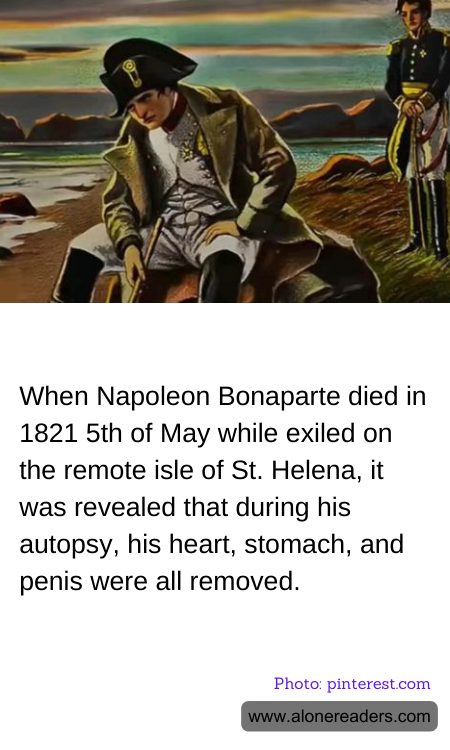
Napoleon Bonaparte, the iconic French military leader and emperor, died on May 5, 1821, in exile on the tiny, remote island of St. Helena in the South Atlantic Ocean. His death marked the end of a tumultuous career that saw him rise from relative obscurity to become one of the most powerful men in Europe. Napoleon was exiled to St. Helena following his defeat at the Battle of Waterloo in 1815, where he spent the last years of his life.
Following his death, an autopsy was carried out by Napoleon's personal physician, Francesco Antommarchi, in the presence of British doctors. The autopsy revealed that he had died of stomach cancer, a diagnosis that was suspected for several years as Napoleon had been suffering from painful stomach ailments. However, it also uncovered something quite unusual: several of his organs were removed during the procedure. Among these were Napoleon's heart, to be returned to France (though it never was), his stomach, in an attempt to better understand the cause of his death, and strikingly, his penis.
The removal of Napoleon's penis, perhaps the most peculiar aspect of this story, has sparked various myths and tales. It was not uncommon during this period for body parts of eminent individuals to be taken as souvenirs or for scientific study. However, the journey of Napoleon’s penis post-mortem reads almost like a tale of its own. Taken by the priest Vignali, who conducted the last rites, it changed hands several times over the centuries, even being displayed in New York City in the 1920s. It was eventually sold to an American urologist in the 1970s.
The dissection and subsequent removal of his organs reflect the era's fascination with autopsies and the human body, particularly the bodies of famous figures. During the 19th century, there was a popular belief that analyzing the body parts of great leaders could provide insights into their characters and, by extension, their greatness.
Napoleon Bonaparte’s legacy is vast, influencing military tactics, law (through the Napoleonic Code), and governance across the world. Yet, even in death, he continued to provoke curiosity and debate, evidenced not only by discussions over his cause of death and the condition of his health but also the almost macabre fascination with his bodily remains. The story of his dissected body parts traversing continents and the centuries is a bizarre footnote in the complex narrative of one of history's most renowned figures.