More About This Card
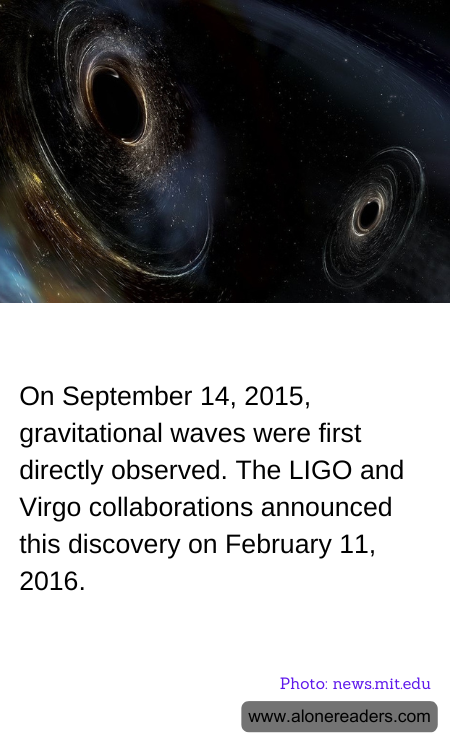
On September 14, 2015, a monumental event in the field of astrophysics occurred when gravitational waves were detected directly for the first time. This historical detection was made possible by the advanced Laser Interferometer Gravitational-Wave Observatory (LIGO), in collaboration with the Virgo observatory. The official announcement of this groundbreaking discovery, however, was not made until February 11, 2016, which allowed time for the necessary data verification and analysis.
Gravitational waves are ripples in the fabric of space-time caused by some of the most violent and energetic processes in the Universe. Albert Einstein first predicted the existence of gravitational waves in 1916, based on his theory of general relativity. Einstein’s mathematics showed that massive accelerating objects (such as neutron stars or black holes orbiting each other) would disrupt space-time in such a way that waves of distorted space would radiate from the source. These waves travel at the speed of light, carrying with them information about their origins, as well as about the nature of gravity itself.
The observation of these waves represents a major triumph in the field of astrophysics. It provides a new way to observe the cosmos, complementary to the traditional methods that rely predominantly on light (electromagnetic radiation). This innovation opens up a fresh avenue for observing and understanding the universe's most mysterious phenomena, such as black holes and neutron stars.
The detected gravitational waves were produced during the final fraction of a second of the merger of two black holes to produce a single, more massive spinning black hole. This collision of two black holes had been predicted but never observed. The gravitational waves from the event traveled to Earth, taking over a billion years to arrive. This marked not only a breakthrough in our understanding of the cosmos but also a technical achievement in measuring these waves, which are incredibly minuscule oscillations in space itself.
The technology behind the detection of gravitational waves is as impressive as the scientific implications of the finding. LIGO's observatories in Washington and Louisiana consist of two enormous laser interferometers located thousands of miles apart. Each interferometer has two arms which are 2.5 miles (4 km) in length. Lasers beam along these arms and precisely measure their lengths. When a gravitational wave passes by Earth, it alters the physical length and the relative alignment of the arms, which LIGO can detect.
This new era of gravitational wave astronomy will deepen our understanding of the universe, offering insights into the behavior of matter and energy as they interact in the most extreme conditions in the universe. The success of LIGO and Virgo paves the way for future observation missions and points towards a future where gravitational wave observations become a regular part of astronomical practice.