More About This Card
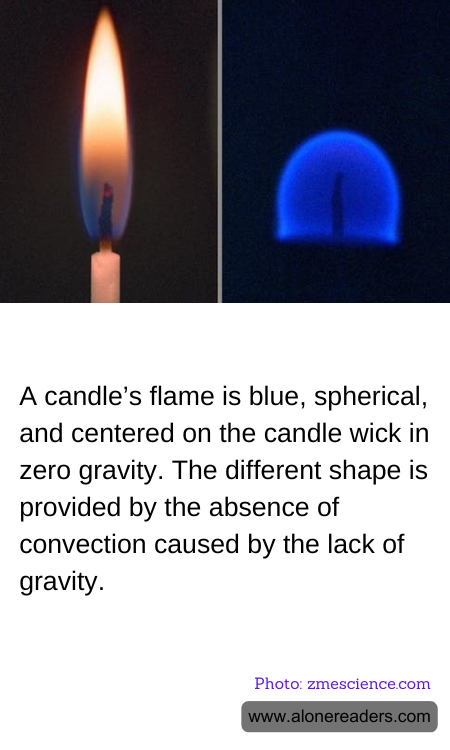
In the unique environment of zero gravity, the behavior and appearance of a candle flame differ significantly from what we observe on Earth. Under normal circumstances, a candle flame takes on a teardrop shape due to the effect of gravity on the hot gases emitted during combustion. Hot air, being lighter than cooler air, rises while pulling in cooler, oxygen-rich air from the surroundings, creating both the shape and the flicker of the flame.
However, in zero gravity, such as aboard a space station, this convection process does not occur because there is no "up" or "down" to dictate the direction in which the lighter gases can move. As a result, the flame becomes spherical and blue. This change in shape occurs due to the even distribution of heat and gases in all directions around the wick. The blue color, which can sometimes be seen at the base of a candle flame on Earth due to it being the hottest part of the flame, becomes more prominent in zero gravity. This is primarily because the complete combustion process in zero gravity allows for a more thorough consumption of the candle’s fuel, producing carbon dioxide and water vapor without residual soot particles, leading to a cleaner and bluer flame.
The implications of such behavior in zero gravity extend beyond aesthetic differences and have practical implications in the fields of space travel and environmental control within spacecraft. Understanding the combustion process without the influence of gravity helps scientists and engineers design more efficient energy sources and safety measures for long-duration space missions. Moreover, studying combustion in zero gravity can offer insights into pollution control technologies and advanced combustion systems on Earth by understanding how flames behave in a perfect combustion environment.
Therefore, the phenomenon of a candle’s flame in zero gravity not only offers a captivating visual but also enriches our understanding of fundamental physical processes, contributing to advancements in both space technology and terrestrial combustion research.