More About This Card
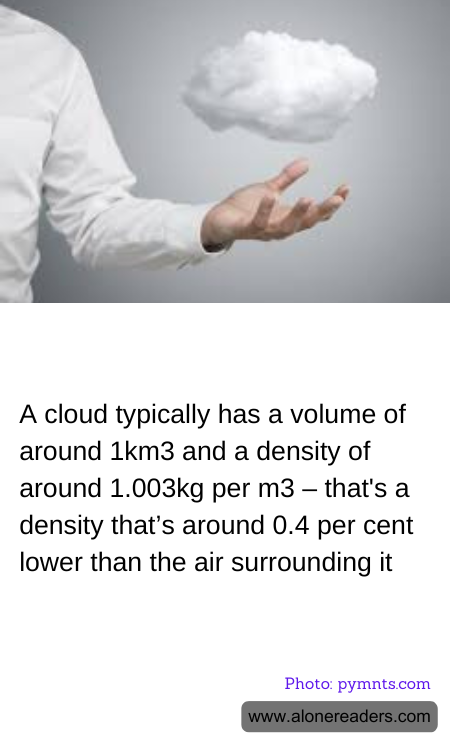
Clouds, those fluffy, drifting bodies in the sky, are an integral part of Earth's atmosphere and weather systems. Surprisingly, despite their often massive appearances, clouds are less dense than the air around them—approximately 0.4 percent less dense, in fact. The density of a typical cloud is about 1.003 kilograms per cubic meter, whereas the density of dry air at sea level and 20°C is around 1.204 kilograms per cubic meter.
A cloud's comparatively low density is due to the moisture contained within it. Water vapor, which forms clouds, is lighter than the nitrogen and oxygen molecules that dominate in the atmosphere. When water vapor condenses into microscopic droplets or ice crystals, these tiny particles are spaced relatively far apart compared to the molecules of dry air, contributing to the overall lower density of the cloud.
The average volume of a cloud is another intriguing aspect. While they can vary greatly in size, a typical cumulus cloud is about 1 cubic kilometer in volume. This might be difficult to visualize, but imagine a cube with sides of about 1,000 meters; the cloud fills that entire space.
While their low density allows them to float in the sky, clouds are not weightless. That same 1 cubic kilometer of cloud contains approximately 1,003 kilograms of water. This might seem light considering the volume, but it translates to over a million grams of water floating above our heads—in some cases, much more, depending on the type of cloud and the conditions present.
Clouds play a critical role in Earth's climate and weather. They affect the planetary and local temperatures by reflecting sunlight back into space (albedo effect) and by trapping warmth in the atmosphere (greenhouse effect). They are essential in the distribution of fresh water across the globe, as they transport moisture from one place to another and eventually release it as precipitation.
Understanding the properties of clouds, such as their density and volume, is crucial for meteorologists and climate scientists as they predict weather patterns and study atmospheric processes. Through the continual study of clouds, scientists can refine our understanding of climate systems, enabling better predictions of weather and climate impacts in a rapidly changing world.