More About This Card
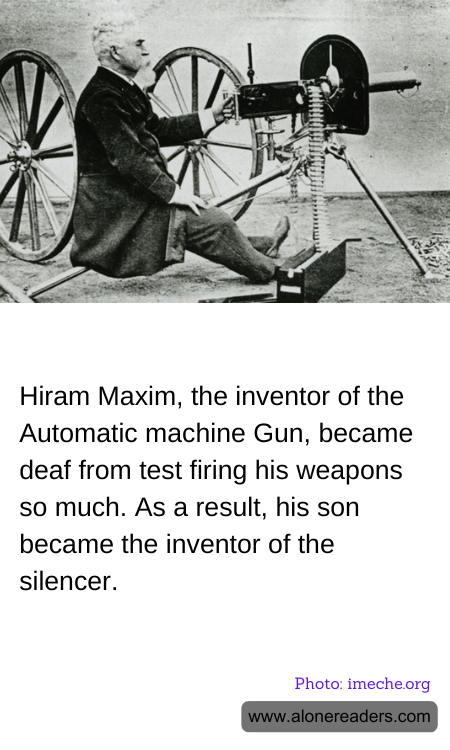
The invention of the automatic machine gun by Hiram Maxim in the late 19th century marked a revolutionary advance in military technology, fundamentally changing the nature of warfare. Hiram Maxim, an American-born inventor who later moved to Britain, demonstrated the profound impact of relentless experimentation and innovation. However, this advancement came at a personal cost. Maxim's extensive testing of his own creations, notably the Maxim gun—the world's first recoil-operated machine gun—ultimately led to his hearing loss. This profound effect of his work highlighted not only the physical risks inventors might endure but also the direct consequences of their inventions.
In an intriguing twist of fate and perhaps inspired by his father's ailment, Hiram Maxim's son, Hiram Percy Maxim, took a slightly different path in the world of inventions. Seeing the effects of loud gunfire firsthand, Hiram Percy was motivated to mitigate such hazards and improve the general usability of firearms. This led him to invent the firearm silencer. His invention, although initially met with mixed responses, represented a significant leap in firearm technology. While today the term "silencer" can be misleading—as such devices do not completely silence but rather suppress the sound of gunfire—it highlights the ongoing quest within the field of firearms technology for enhancements that address both functionality and safety issues.
Interestingly, the development of the silencer, or suppressor as it is more accurately called, has served various purposes beyond just protecting the hearing of shooters. It reduces noise pollution, decreases recoil, and helps prevent giving away the position of the shooter, which can be crucial in hunting and tactical scenarios. The impact of Hiram Percy Maxim's invention thus extends into modern considerations of firearm usage, balancing effectiveness with considerations of environmental and personal safety.
This narrative of father and son—where the father revolutionizes warfare with a new weapon and the son seeks to refine the use of such weapons through innovative safety measures—encapsulates a fascinating family legacy in the annals of technological progress. Their contributions also pose ethical questions about the responsibilities of inventors and the implications of their inventions, echoing ongoing debates in many fields of modern engineering and technology development.