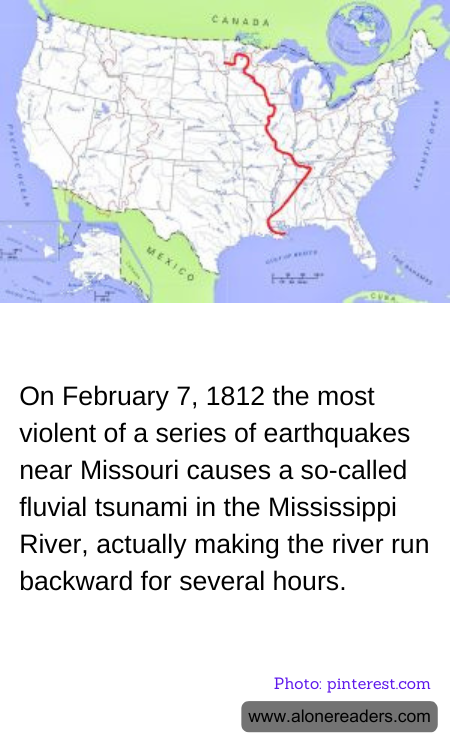
The New Madrid earthquakes of 1811-1812, named after the nearby town of New Madrid in Missouri, represent some of the most powerful seismic events in the recorded history of the continental United States. Among these, the earthquake that occurred on February 7, 1812, stands out due to its exceptional intensity and unusual phenomena, one of which was the remarkable reversal of the flow of the Mississippi River.
This seismic event reached an estimated magnitude of 7.5 to 8.0, striking the central part of the country near the Mississippi River. The quake was so intense that it was felt as far away as New York City and Boston, which are over 1,000 miles from the epicenter. Its power disrupted the landscape to such an extent that it temporarily transformed the course of the Mississippi River.
The river running backward was an extraordinary sight reported by many witnesses. This phenomenon was caused by the earthquake’s seismic waves pushing up riverbeds, leading to the formation of temporary waterfalls in the Mississippi River. As the river struck these barriers, the flow was forced to reverse, creating a "fluvial tsunami." For several hours, the river appeared to defy nature by flowing northward instead of its natural southern direction.
In addition, the shaking resulted in the formation of Reelfoot Lake in northwestern Tennessee, as sections of the riverbed and surrounding marshes subsided. These dramatic alterations to the geography showcase just how powerful the New Madrid earthquakes were.
The event had significant consequences for the communities along the river, both Native American tribes and European settlers, who relied on the Mississippi for transport and trade. The seismic activity reshuffled the region’s river routes and navigability, revealing the destructive power hidden beneath the seemingly calm landscapes of the Midwest and underscoring the volatility of the Earth’s geologic processes. This unusual reversal of the Mississippi River is not just a historical footnote but a reminder of the powerful forces that can dramatically reshape our environment in a matter of moments.
