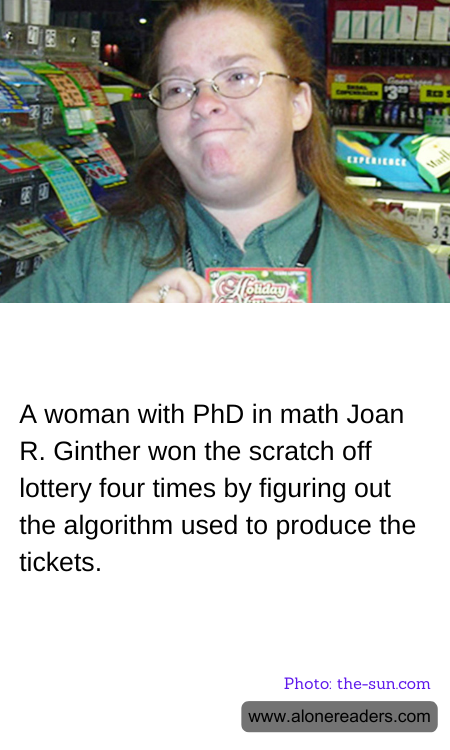
More About This Card
Joan R. Ginther is sometimes referred to as the "luckiest woman in the world," but there might be more to her story than mere luck. A woman holding a PhD in math from Stanford University, Ginther won large payouts from scratch-off lottery tickets four times, amassing winnings totaling over $20 million. Her unusual success at winning multiple high-value lottery prizes has sparked discussions and theories about whether she used her mathematical skills to uncover patterns or algorithms in the lottery ticket production.
Ginther's first win came in 1993, followed by subsequent wins in 2006, 2008, and 2010, respectively. All of her winning tickets were purchased in Texas, with a significant number bought from the same convenience store in the small town of Bishop. This pattern led to increased speculation about whether Ginther had developed a statistical strategy to improve her chances.
The lottery system uses a pseudo-random algorithm to distribute winning tickets, ensuring a mix of winning and losing tickets throughout the production run. Some believe that by analyzing the distribution of tickets and understanding the algorithm's logic, Ginther could predict where winning tickets were more likely to appear. This theory posits that through a combination of mathematical skill, geographic analysis, and possibly an in-depth understanding of random number generation, Ginther could systematically increase her odds of purchasing a winning ticket.
However, without concrete evidence or public confirmation from Ginther herself, who has remained quite private about her wins and her methods, it remains primarily speculative. Lottery companies maintain that their systems are secure and fair, designed to prevent any individual from gaming the system. They emphasize the random nature of lottery ticket wins and the independent verification processes designed to safeguard the integrity of the lottery process.
While the idea that someone could use mathematical prowess to uncover patterns in lottery ticket distribution is intriguing, it raises important questions about fairness and the security of lottery games. If Ginther did indeed use her mathematical background to decipher patterns, it highlights a potential vulnerability in the lottery system that could be exploited by someone equipped with the right knowledge and resources.
In the absence of solid proof or an admission from Ginther herself, her story remains one of incredible luck—or an extraordinary testament to the power of mathematics. It serves as a compelling narrative about the possibilities of applying advanced analytical skills in unexpected realms, potentially redefining what we consider to be luck or mere chance.