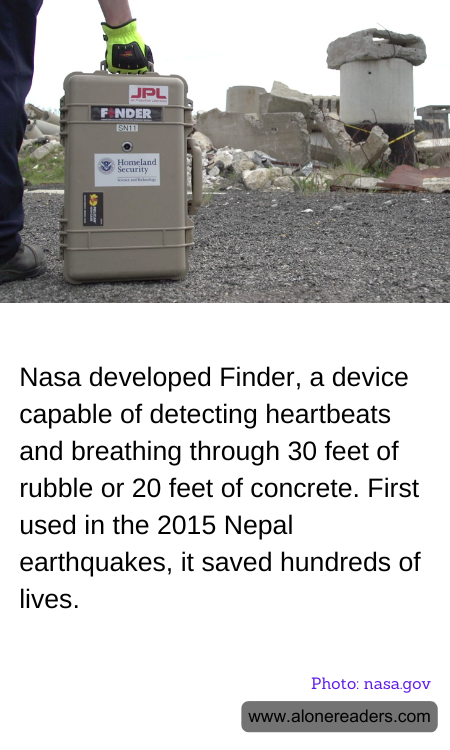
In the wake of natural disasters, the swift location and rescue of trapped victims can mean the difference between life and death. NASA, primarily known for its exploration of space, has also channeled its technology and resources towards terrestrial humanitarian efforts. One significant contribution is the development of FINDER (Finding Individuals for Disaster and Emergency Response), a cutting-edge technology capable of detecting human heartbeats and breathing patterns through substantial barriers. This device can penetrate up to 30 feet of densely packed rubble or 20 feet of solid concrete, making it an invaluable tool in the aftermath of disasters like earthquakes and bombings.
FINDER was first deployed in a real-world scenario during the devastating earthquakes in Nepal in 2015. The country was struck by a massive 7.8 magnitude quake, followed by numerous aftershocks, resulting in widespread destruction and thousands of casualties. Traditional search and rescue methods were hampered by the extensive debris and unstable structures, thus limiting the speed and scope of initial rescue efforts.
However, FINDER proved to be a game-changer. By using advanced radar technology, the device identifies the tiny, periodic movements caused by human breathing and heartbeats, distinguishing them from other random movements in the rubble. This capability allows rescue teams to quickly locate living victims trapped beneath the debris, dramatically increasing the chances of rescue and survival. During its deployment in Nepal, FINDER was instrumental in saving several lives, proving its effectiveness in real-world disaster scenarios.
The implications of FINDER's success are profound. Implementing this technology can significantly enhance emergency response strategies globally, particularly in earthquake-prone regions. This device not only highlights the potential for space technology to be applied in disaster response scenarios but also sets a precedent for future innovations in life-saving apparatus.
Overall, FINDER is a testament to the ongoing efforts and commitments of organizations like NASA to utilize their expertise and technology for global benefit. By crossing the boundaries between space exploration and terrestrial applications, NASA continues to play a pivotal role in enhancing human safety and disaster response capabilities worldwide.
