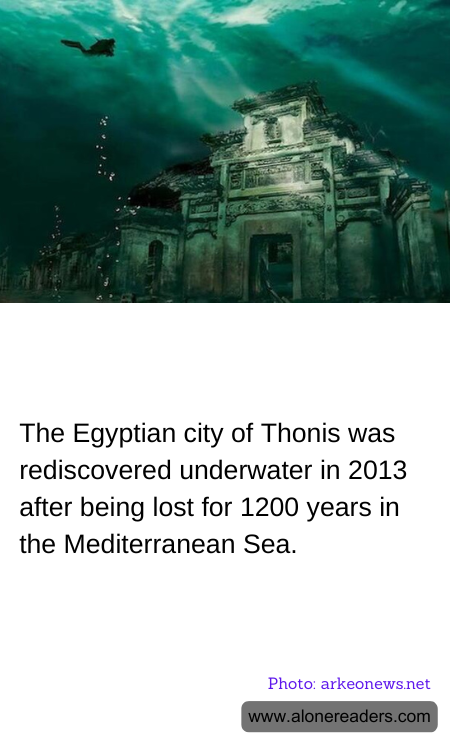
The rediscovery of Thonis, also known as Heracleion by the ancient Greeks, in 2013 marked a major milestone in underwater archaeology. Submerged for over 1,200 years in the Mediterranean Sea near the mouth of the Nile, Thonis was at one point a bustling port city, serving as the gateway to Egypt. Its strategic location made it a vibrant hub of activity, where trade and cultural exchange flourished. The story of its disappearance until its rediscovery encapsulates a fascinating chapter of history that combines natural phenomena with the ancient world’s complex socio-political landscape.
The exploration and excavation of Thonis have been led by Franck Goddio and a team from the European Institute for Underwater Archaeology. They revealed remarkably preserved artifacts, including statues, gold coins, and the remains of ships that lay hidden beneath layers of sea sediment. The findings suggest that Thonis-Heracleion was not only economically significant but also a religious and cultural center. Among the notable discoveries was a grand temple dedicated to the god Amun-Gereb, the supreme god of the Egyptians during that era, and various other smaller shrines adorned with votive offerings.
The cause of Thonis's submersion is believed to be a combination of factors, including subsidence induced by geological instabilities and rising sea levels. Over time, these elements led to the city being swallowed by the sea, leaving behind a legacy lost in waters until its extraordinary rediscovery. The artifacts retrieved from the site have provided historians and archaeologists with invaluable insights into the life and times of its inhabitants and the dynamic nature of ancient Egyptian civilization.
Moreover, the study of Thonis has contributed to a deeper understanding of Egyptian urban planning, architecture, and the complexities of ancient trade networks. The detailed examination of the relics continues to reveal the intricate relationships between the Egyptians and their neighboring civilizations, such as the Greeks and Romans. The discovery of Thonis has, thus, not only brought an ancient city back to memory but also enriched our understanding of historical interactions across the Mediterranean region.
In essence, the uncovering of Thonis is a testament to the power of modern archaeological methods and the enduring intrigue of ancient civilizations. It serves as a crucial reminder of the cultural and historical legacies that lie submerged beneath our oceans, waiting to be discovered and telling tales that have shaped human history in innumerable ways. The ongoing study of this lost city continues to captivate and educate, bridging past and present through the recovery of its hidden treasures.
