More About This Card
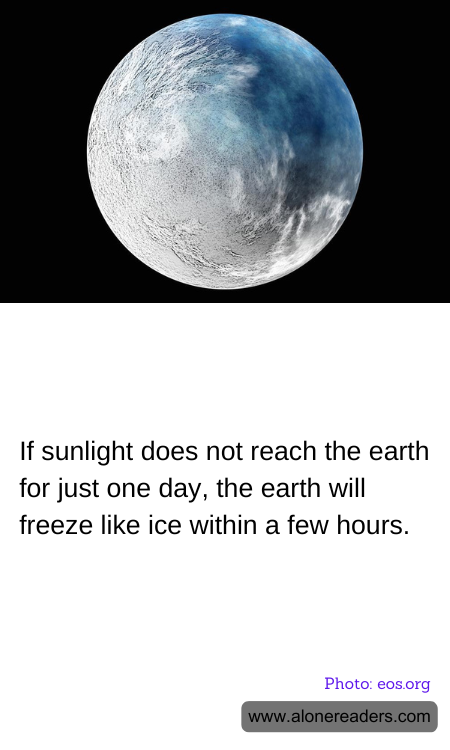
The impact of sunlight not reaching Earth for a day is a thought-provoking scenario that brings to light the significance of the sun in our solar system. However, the idea that Earth would freeze like ice within a few hours if sunlight were blocked for a day is a bit of an exaggeration. Let's explain why this wouldn't be the case.
Firstly, it's fundamental to recognize that the Earth has a relatively thick atmosphere which acts as a blanket, insulating and regulating the planet's temperature. This atmospheric layer is adept at trapping heat through various greenhouse gases like carbon dioxide and methane. Consequently, if sunlight were to be blocked, the Earth would indeed begin to cool, but not instantaneously or as drastically as one might presume.
The heat accumulated in the Earth's atmosphere, oceans, and surface would begin to radiate back into space, but this process would take time. The concept of thermal inertia means that just as it takes time for the Earth to heat up, it similarly takes time for it to cool down. Oceans, which cover about 71% of the Earth’s surface, have an immense capacity to store heat, thereby acting as buffers against sudden temperature changes. Hence, a single day without sunlight would begin to lower temperatures, particularly at the surface and in the air, but not to freezing extremes globally.
Moreover, localized effects would vary. Regions accustomed to consistent sunlight and higher temperatures might experience more noticeable drops in temperature. However, parts of the world like the deep ocean or geothermally active areas would see minimal immediate change. For instance, volcanic regions and areas with significant geothermal activity might not experience much of a temperature drop at all.
In the hypothetical situation where sunlight is blocked for an extended period, say weeks to months, the consequences would be more severe, potentially leading to a scenario akin to what is described as a "nuclear winter." In such an extended scenario, photosynthesis would halt, disrupting ecosystems and food chains, leading to a more significant and profound global impact.
In summary, the absence of sunlight for just a day would lead to a decrease in temperatures, potentially making it considerably cooler, especially during what would have been daylight hours. However, the notion of the Earth freezing over like ice within a few hours is unlikely due to the mitigating effects of the Earth's atmospheric insulation and the thermal inertia of its oceans and surface. Such a swift and extreme change requires more prolonged absence and additional factors influencing Earth's climatic systems.