More About This Card
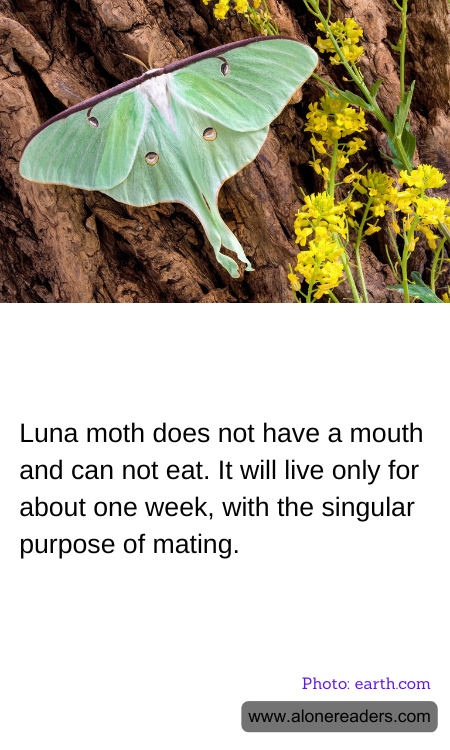
The Luna moth, known scientifically as Actias luna, is one of the most striking and easily recognizable moths due to its luminous green color and long, graceful tail streamers. What makes the Luna moth particularly unique, however, is its lack of a mouth. Once it emerges from its cocoon as a fully formed adult, it does not eat at all. Instead, the Luna moth survives off the energy it stored as a caterpillar, which it must use carefully to fulfill its final purpose: reproduction.
The lifespan of a Luna moth is incredibly short, lasting only about a week. During this brief time, the moth's sole mission is to find a mate. The absence of a mouth means that every moment of its adult life is devoted to this singular goal, for without the distraction of feeding, the moth is entirely focused on ensuring the continuation of its species.
Male and female Luna moths have evolved different strategies to meet each other in the vast night. Males are equipped with large, feather-like antennae that are highly sensitive to the pheromones released by females. This biological adaptation allows them to detect potential mates from great distances. After mating, the female lays her eggs on the underside of leaves, which will become food for the larvae once they hatch.
The life cycle of the Luna moth is a beautiful example of nature's focus on survival and reproduction. After hatching from the eggs, the larvae, or caterpillars, spend their time eating and growing, undergoing several stages of metamorphoses where they grow significantly in size. Their diet mostly consists of leaves from trees like the sweetgum, walnut, and hickory. As they transition into pupae, they wrap themselves in cocoons where they undergo a complete transformation, re-emerging into the adult moths that captivate human observers.
The Luna moth's existence, though fleeting, serves as a reminder of the beauty and brevity of life. They remind us of the sacrifices organisms must sometimes make for the survival of their species. Their short adult life, devoted entirely to reproduction, highlights an incredible evolutionary strategy that prioritizes the future generations over the individual. It's a poignant example of nature's intricate balance of survival, sacrifice, and beauty.