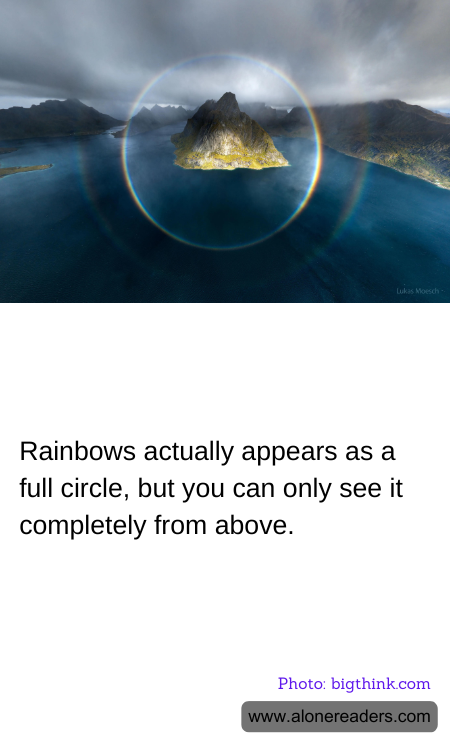
Rainbows, a colorful and ethereal natural phenomenon, are commonly recognized as a semi-circular arc in the sky following rainfall. However, most people don't realize that rainbows are actually full circles. The reason we typically see only a semi-circle is due to the observer's ground-level perspective. From this viewpoint, the ground obscures the bottom half of the rainbow, hiding it from sight.
The science behind rainbows reveals how they are formed and why their true shape is a complete circle. Rainbows occur when light, usually from the sun, reflects off water droplets in the atmosphere. This light is both refracted as it enters the droplet and again as it exits, apart from being reflected internally. The refraction and the reflection within the droplets result in the splitting of light into various colors at different angles, creating a spectrum. This process is known as dispersion, and it happens because different colors of light bend by different amounts due to their varying wavelengths.
The complete circular nature of a rainbow can only be observed under specific conditions. Typically, this full view can be seen from higher elevations or from an aircraft looking downwards at an angle where no ground is visible to block the view. Pilots often report seeing entire circular rainbows around the shadow of their airplane on a cloud layer below—a phenomenon known as a “glory.”
This spectacle not only showcases the raw beauty of nature but also highlights the complex interactions of light and natural elements. When viewed from above, where no obstruction from the landscape interferes, the rainbow reveals itself as a full circle, floating majestically in the vast expanse of the sky. Such instances remind us that our everyday perspective can limit our perceptions of natural phenomena and that there’s often more to discover when we change our viewpoint or look a little closer.
