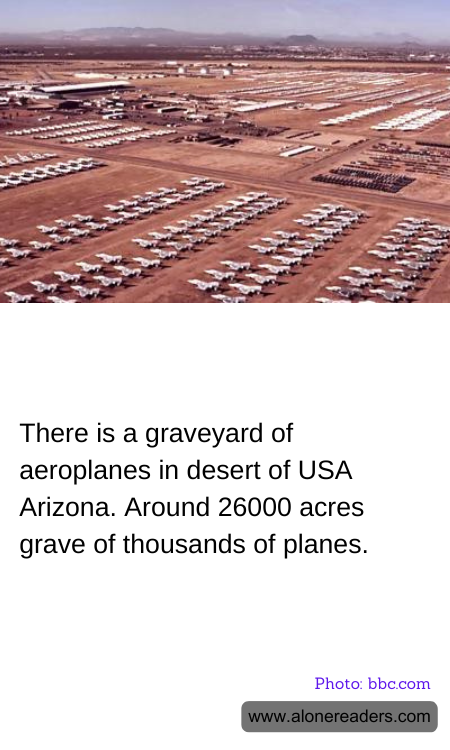
In the vast expanses of the Arizona desert, an extraordinary sight unfolds—an immense collection of aircraft, from retired fighter jets to decommissioned commercial airliners, forming what is commonly known as a "boneyard." Spread over approximately 26,000 acres, this site serves as the final resting place for thousands of airplanes, marking it as one of the largest airplane graveyards in the world.
Located near Tucson, Arizona, the primary facility responsible for this accumulation of aviation history is the 309th Aerospace Maintenance and Regeneration Group (AMARG), a part of the United States Air Force. The desert's arid conditions, with low humidity and scant rainfall, provide an ideal environment for preserving the metallic bodies of airplanes, minimizing rust and corrosion. This natural preservation factor is crucial for storing aircraft that might be called back to service, dismantled for parts, or simply recycled.
The aircraft at AMARG arrive from various military branches and government agencies, including the U.S. Air Force, Navy, Marine Corps, Coast Guard, and even from allied nations. Once an airplane arrives, it undergoes a preservation process known as "pickling." Fluids are drained, openings are sealed with protective covers, and a special spray-latex compound is applied to protect sensitive areas from environmental exposure.
For those with a historical or technological fascination with aviation, the site is not merely a junkyard but a veritable archive of aerospace technology and design, chronicling the evolution of aircraft over decades. Researchers and historians value this site for the wealth of information it holds and the potential insights into advances in aerospace technology and materials science.
Moreover, AMARG plays a crucial role in parts reclamation. It serves as a key resource for spare parts which are often out of production and hard to find. This reclamation process helps in maintaining active aircraft, thereby saving millions of dollars.
For the public and aviation enthusiasts, the Pima Air & Space Museum nearby offers tours that venture into this vast airplane boneyard, providing a close view of the history and scale of the facility. These tours showcase not only the impressive logistics of maintaining such a large reserve of aircraft but also highlight the strategic significance and economic efficiency of the program.
In sum, the airplane graveyard is a stunning example of both decay and preservation, serving multiple purposes from historical preservation to economic utility, embodying an important aspect of America's military and aerospace prowess.
