More About This Card
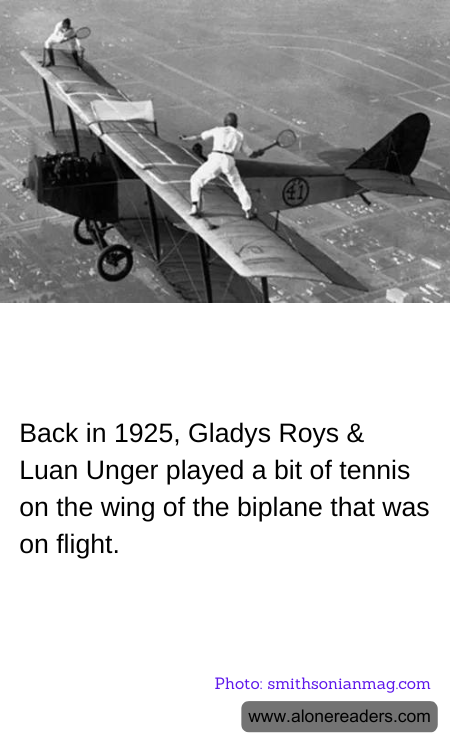
In the thrilling arena of aerial stunts, few episodes are as breathtaking and distinctly memorable as the one that took place in 1925. Gladys Roys and Luan Unger, both daring souls of their era, astoundingly played tennis on the wing of a biplane while it was in flight. This audacious display not only showcased their incredible bravery but also marked a unique moment in the annals of aviation stunts.
During the early 20th century, aviation was still in its developmental stages, a field ripe with both opportunity and peril, attracting thrill-seekers driven to test the limits of human capabilities and mechanical possibilities. Roys and Unger, participating in what was arguably a publicity stunt designed to garner attention and awe, took the game of tennis to an unprecedented altitude—both literally and metaphorically.
The event was meticulously planned. The aircraft involved was a Curtis biplane, specially modified to allow the stunt to take place. A platform was constructed over the wings right in front of the biplane’s open cockpit, providing just enough space for Roys and Unger to rally the ball. Given the wind speeds and the vibrations inherent to the primitive engineering of early planes, maintaining balance while hitting a tennis ball was a feat requiring precise timing, immense courage, and a deep trust in the pilot's skills.
Photos capturing this stunt show Roys and Unger, in tennis attire, rallying back and forth as the biplane soared. These images are not only spectacular but radiate a certain audacity that characterized much of the Roaring Twenties—a time when societal norms were tested and boundaries pushed, often dramatically.
Though it's unlikely that a standard game of tennis unfolded on the wing of the biplane, the symbolic significance and the sheer visual impact of the stunt did exactly what it was intended to do: draw gasps and headlines. Furthermore, it underscored the era’s fascination with stunts that combined sports, technology, and spectacle, reflecting a society increasingly enthralled with speed, heights, and the promise of unlimited possibilities.
The stunt by Roys and Unger remains an extraordinary example of the lengths to which individuals have gone to marry sport with spectacle. Their game of "wing tennis" is a testament to the fearless spirit of adventure that characterized much of early aviation history and continues to inspire aviators and athletes alike.