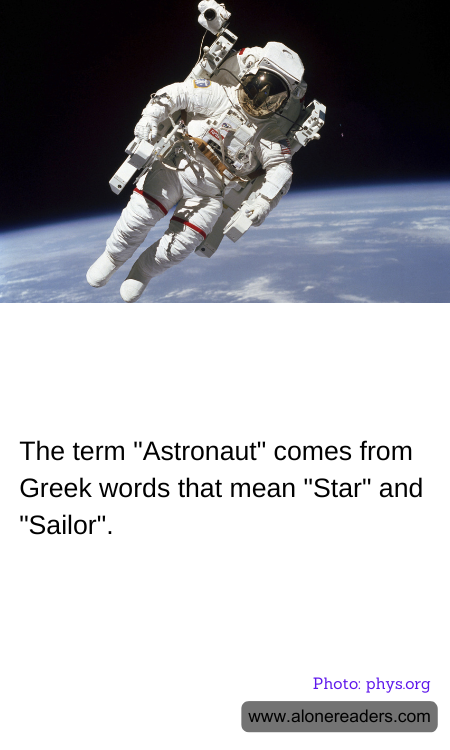
The awe-inspiring title of "astronaut" encapsulates the spirit and adventure of those who venture beyond our home planet. This term roots deeply in the Greek language, stemming from the words "astron" which means "star," and "nautes," which translates to "sailor." Thus, an astronaut is essentially a "star sailor," a voyager navigating the vast ocean of space. The poetic nature of the term perfectly reflects the boundless curiosity and bravery of those select individuals who explore the outer reaches of our understanding and experience in the universe.
The concept of astronauts, or star sailors, emerged long before humanity could actually travel to space. The term itself was symphonically matched to the technological advances that made space travel possible. It was first used in the 20th century as various nations began to seriously pursue the realms beyond Earth's atmosphere. In the United States, astronauts are the brave individuals trained and employed by NASA to command, pilot, or serve as crew members on spacecraft. Differently, in Russia, such individuals are referred to as "cosmonauts," with "cosmos" implying the universe or space, and in China, they are known as "taikonauts," derived from "taikong," meaning space.
As the field of space exploration has evolved, so too has the definition and scope of what it means to be an astronaut. The early days focused primarily on the mechanics of space travel—how to get there and return safely. Now, the role of astronauts involves conducting complex scientific research, participating in experiments that study the effects of microgravity, and engaging in spacewalks to maintain and upgrade spacecraft and satellites. These tasks require rigorous training and a deep understanding of multiple scientific disciplines.
Moreover, being an astronaut today also involves a certain level of diplomacy and cross-cultural collaboration. With the International Space Station (ISS)—a symbol of international partnership—astronauts work side by side with peers from around the world, sharing knowledge, experiences, and goals. This collaboration not only furthers scientific and technological progress but also fosters international goodwill and peace.
The term "astronaut" continues to captivate the imagination and inspire people of all ages. It represents a pinnacle of human achievement and serves as a reminder of what humanity can reach when driven by curiosity and guided by courage. As we stand on the brink of new space exploration endeavors, including returning to the Moon and eventually setting foot on Mars, astronauts remain at the forefront, not just as explorers but as ambassadors of Earth, sailing across the stars.
