More About This Card
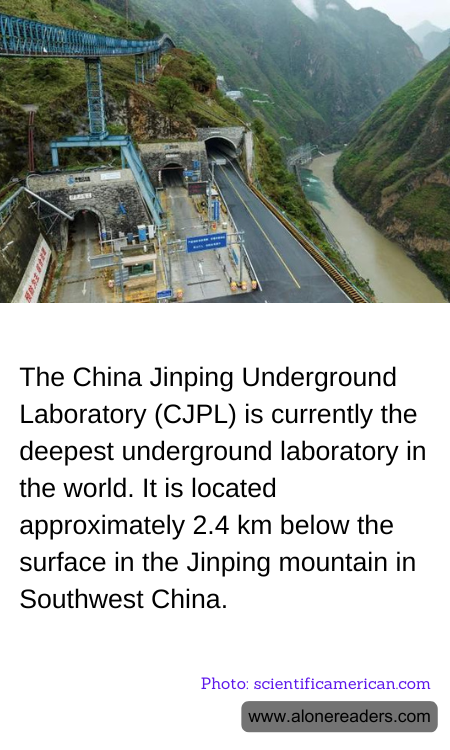
The China Jinping Underground Laboratory (CJPL), nestled deep within the Jinping Mountain of Southwest China, holds the distinction of being the world’s deepest underground laboratory. Burrowed approximately 2.4 kilometers beneath the surface, this facility offers an unparalleled environment for scientific research, particularly in the fields of particle physics and other disciplines requiring minimal interference from cosmic rays. Due to its depth, the CJPL benefits from one of the lowest cosmic ray fluxes on the planet, making it an ideal setting for experiments like dark matter searches and neutrino detection.
The significant reduction of cosmic radiation in such deep locations allows researchers at CJPL to operate highly sensitive equipment that would otherwise be too prone to background noise in less shielded environments. This has positioned the laboratory as a cornerstone of international physics research, addressing some of the deepest questions about the universe’s fundamental components and forces.
Designed to facilitate cutting-edge research, the CJPL has hosted several notable experiments, including the PandaX project, aimed at detecting particles of dark matter. The elusive nature of dark matter makes it undetectable through direct observation; hence, researchers rely on these underground facilities to increase the likelihood of capturing rare interactions between dark matter particles and ordinary matter.
Beyond its contributions to particle physics, the laboratory’s underground setting also provides a controlled, stable environment beneficial for other scientific inquiries including geophysics and biology. In geophysics, the deep-earth setting allows for the study of geoneutrinos and the Earth’s radiogenic heat production, offering insights into the planet’s formation and thermal history. Meanwhile, in biology, scientists explore how life adapts to extreme conditions, providing data relevant to both evolutionary biology and the search for life on other planets.
As CJPL continues to expand its facilities and equipment, it stands as a testament to the power of international collaboration in science, drawing researchers from around the globe. Its continued development not only promises to yield further insights into the fundamental particles and forces that govern our universe but also underscores the importance of investing in unique, technically challenging research environments to tackle some of the most profound mysteries of science.