More About This Card
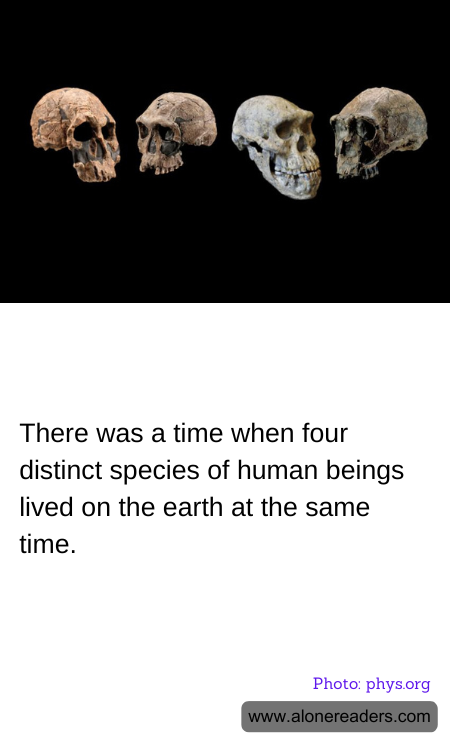
Imagine a world where Homo sapiens, the species to which all modern human beings belong, shared the planet with three other species of humans. This scenario isn't a work of fiction, but a reality that existed around 50,000 to 30,000 years ago. During this period, our ancestors coexisted with Neanderthals, Denisovans, and Homo floresiensis, each species remarkably different yet intricately linked to our own evolutionary pathway.
Neanderthals are perhaps the best-known of our ancient cousins, robust and rugged with characteristics adapted to the harsh climates of Europe and parts of Asia. Their robust physique was built to withstand the cold, and they were proficient hunters of large megafauna. Neanderthals also demonstrated significant cognitive abilities and cultural complexity, evidenced by their tool use and evidence of symbolic art.
In Asia, particularly Siberia, lived the Denisovans, a species identified primarily through genetic traces and a few fossil remnants. Though we know less about the Denisovans than Neanderthals, genetic evidence indicates that they were remarkably different from us and the Neanderthals, and they adapted to a wide range of environments. Intriguingly, modern human populations, particularly those in Oceania and parts of East Asia, carry snippets of Denisovan DNA, suggesting past interbreeding and a shared history.
On the island of Flores in Indonesia, another group, Homo floresiensis, often dubbed the "Hobbits" due to their small stature, thrived. These tiny humans stood only about 3.5 feet tall and had brains roughly a third the size of ours. Despite their small brain size, evidence suggests they made stone tools and hunted small elephants and large rodents that shared their island home.
The existence of these four concurrent human species suggests a rich tapestry of human history, marked by migration, adaptation, and interaction. The interbreeding between these groups hints at a complex web of relationships that shaped the genetic makeup of modern humans. Each group brought different strengths and adaptabilities to their environments, and the genetic remnants in modern humans are a testament to the interconnectedness of these diverse human species.
Ultimately, Homo sapiens were the sole survivors of this group, possibly due to our species' adaptability and capability to inhabit diverse environments, alongside our complex communication skills and social structures. The reasons behind the extinction of these other species remain subjects of intense research and speculation, involving factors like climate change, competition, and interactions with Homo sapiens.
Reflecting on this past not only illuminates the complexity of our own species' history but also serves as a poignant reminder of our shared heritage with these relatives, who played a part in shaping who we are today.