More About This Card
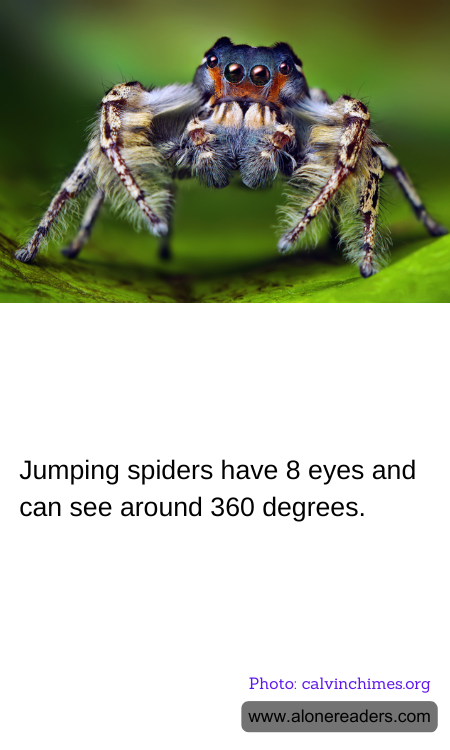
Jumping spiders, a group known scientifically as Salticidae, possess a fascinating and highly efficient visual system. With eight eyes in total, these spiders have one of the most elaborate arrangements seen in arachnids. Their eye configuration grants them an ability to perceive their surroundings in a nearly complete 360-degree view. This wide field of vision is crucial, supporting their predatory lifestyle which heavily relies on their ability to leap accurately at their prey.
The primary pair of a jumping spider’s eyes, called the anterior median eyes, are particularly large and forward-facing. These eyes are responsible for their excellent spatial acuity and detailed color vision. Unlike humans, whose color vision is based on three primary colors, jumping spiders can see a broader spectrum including ultraviolet light, enhancing their ability to hunt and navigate in various lighting conditions. The secondary eyes, positioned around the head, contribute mainly to motion detection over their wide field of view. This array allows them to detect predators and prey from almost any direction.
Jumping spiders’ visual abilities are further complemented by their unique hunting strategies. They do not build webs to catch prey; instead, they use their acute vision to stalk or ambush their targets. After spotting a potential meal, a jumping spider will carefully measure the distance and then leap with precision to capture it. This method of hunting is often supported by their use of a silk tether as a safety line while they jump, preventing them from falling if they miss the target.
Such impressive visual capabilities also play a critical role in communication among their species. Jumping spiders are known for their complex courtship dances, where males perform elaborate displays involving visual signals to attract females. The accuracy of these visual communications is vital for reproduction and underscores the importance of their direct line of sight in these interactions.
Overall, the jumping spider’s visual system is a remarkable example of evolutionary adaptation, optimizing their abilities for hunting, safety, and communication. This, combined with their agility and precision, makes them one of the most intriguing and effective predators among small insects and arachnids. Their ability to see in such a wide range of perspectives helps ensure their survival in a variety of environments, showcasing the intricate connections between anatomical features and ecological lifestyle.