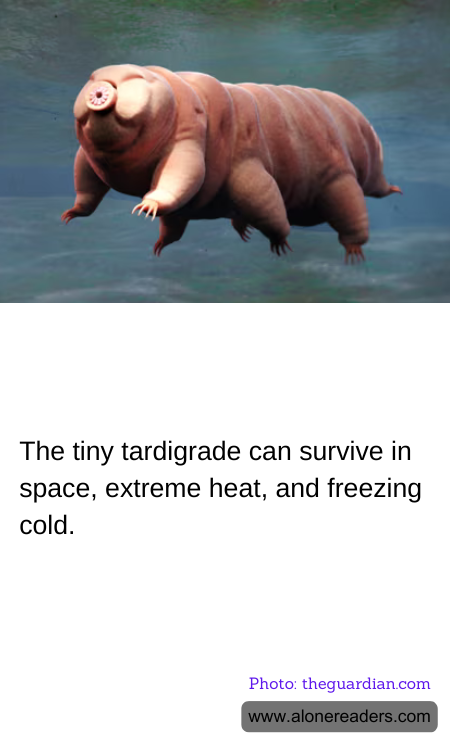
Tardigrades, often called water bears or moss piglets, are microscopic animals renowned for their remarkable resilience and ability to endure extreme environmental conditions. These eight-legged micro-animals measure about 0.5 mm in length when fully grown and are found in some of the most extreme environments on Earth, from the deepest oceans to the highest mountains.
One of the most extraordinary feats of tardigrades is their proven ability to survive in the vacuum of space. In 2007, researchers sent tardigrades into orbit aboard a European Space Agency satellite. Exposed to the harsh conditions of space, including solar radiation and a vacuum, for more than a week, tardigrades not only survived but some even successfully reproduced after returning to Earth. This ability is attributed in part to their unique capability to enter a state called cryptobiosis. In this state, they dry out completely, halting their metabolism and essentially putting them in suspended animation.
In addition to surviving the vacuum and radiation of space, tardigrades can endure temperatures as high as 150 degrees Celsius (302 degrees Fahrenheit) and as low as -272 degrees Celsius (-457.6 degrees Fahrenheit), just above absolute zero. This temperature resilience is unparalleled in the animal kingdom. Tardigrades achieve this by producing a special protein that protects their cells from extreme heat, as well as by synthesizing trehalose, a sugar that prevents ice crystals from forming in their cells, thus protecting them from freezing damage.
Another defining survivability trait of tardigrades is their resistance to extreme pressure. They can withstand the crushing pressure of deep oceans and can even endure the more barren, low-pressure environments that would be typical on the surface of Mars, for instance.
The remarkable survival abilities of tardigrades not only make them a subject of fascination but also a valuable model for scientific study. Researchers hope to apply insights gained from studying tardigrades to develop better ways to preserve vaccines and human cells. Moreover, understanding how tardigrades resist radiation could lead to improved protective measures for astronauts in long-term space missions.
Their resilience raises fascinating questions about the limits of life on Earth and potentially other planets. By studying these tiny survivors, scientists can deepen their understanding of biology, the adaptability of life, and broaden our conception of where life can thrive in the cosmos. Tardigrades, through their sheer tenacity, underscore a critical lesson: life, in its various forms, possesses an astounding capacity to adapt to and endure within the most forbidding environments known.
