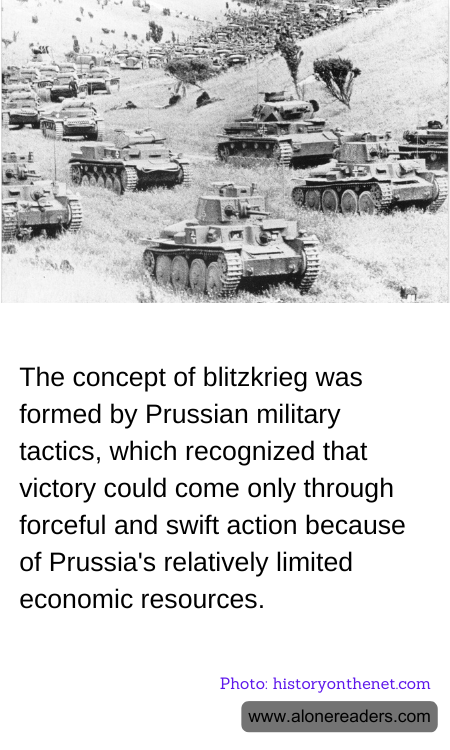
The concept of "blitzkrieg," a German term which translates to "lightning war," revolutionized military strategies in the 20th century. While commonly associated with Nazi Germany during World War II, its roots are tied deeply with Prussian military tactics, reflecting Prussia's historical context of relatively limited economic resources compared to its rivals. Prussia, emerging as a significant European power in the 19th century, strategized to compensate for its economic constraints with rapid and decisive military action, setting a precedent for the blitzkrieg tactics used by Germany later.
Blitzkrieg emphasized rapid movement, concentrating offensive forces on a narrow front to break through enemy defenses using speed and surprise. This approach was designed to avoid the prolonged warfare that had characterized much of European conflict up to that point, which Prussia could ill afford given its economic limitations. The tactic aimed for quick victories that would conserve resources while demoralizing opponents.
World War II saw the effective implementation of these tactics by Nazi Germany, beginning with the invasion of Poland in 1939, followed by swift campaigns in Western Europe in 1940. The German military, utilizing a combination of armored divisions and airpower, executed coordinated assaults that emphasized speed and mobility. This not only allowed them to outmaneuver the enemy but also facilitated the encirclement and destruction of opposing forces.
Blitzkrieg's success in the early years of World War II had a profound impact on subsequent military tactics and doctrines globally, influencing how modern warfare is conducted. However, it also highlighted limitations, as seen in the later years of the war when the Allies adapted and the terrain, supply issues, and extended lines of communication slowed the German advance, eventually contributing to Germany's defeat.
Thus, while blitzkrieg showcased the efficacy of rapid, concentrated force as a military tactic, it also underscored the significant role of logistics, supply chains, and adaptability in sustained military operations. Its origins in Prussian military strategy demonstrate a longstanding principle of leveraging speed and decisive action to overcome economic and resource limitations, a principle that continues to resonate in military strategy theory today.
