More About This Card
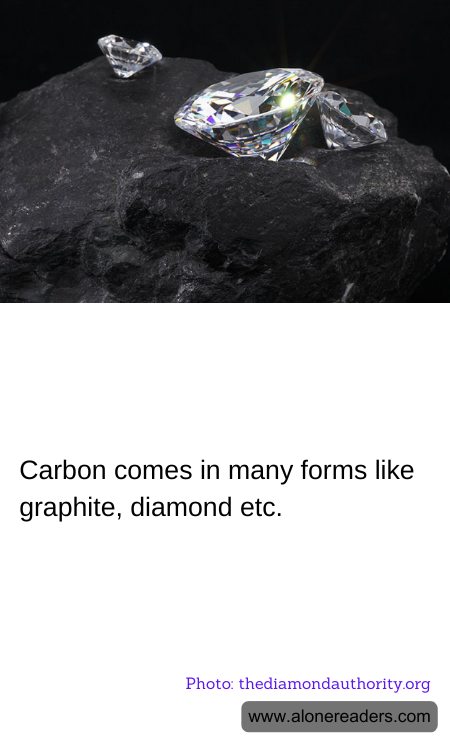
Carbon, a versatile and essential element, is the backbone of all known life on Earth. It is not only fundamental in biology but also remarkably diverse in its forms, which scientists call allotropes. Among the most well-known allotropes of carbon are graphite and diamond, each exhibiting unique properties and uses that make them vital to various industries and advancements.
Graphite is one of the most stable forms of carbon under standard conditions. It is known for its softness and its metallic gray sheen. Structurally, graphite is composed of layers of carbon atoms arranged in a hexagonal lattice. These layers are weakly bonded, allowing them to slide over each other easily, which accounts for graphite's excellent properties as a lubricant and its traditional use in pencils. The ability of graphite to conduct electricity also makes it invaluable in the manufacture of electrodes and batteries.
Diamond, on the other hand, is famed for its unmatched hardness and impressive clarity. It is formed under high-pressure, high-temperature conditions that occur naturally deep within the Earth’s mantle. Here, carbon atoms bond in a three-dimensional framework, creating a crystal lattice that contributes to the diamond's hardness. This makes diamond an ideal material for cutting and grinding tools. Beyond industrial applications, diamonds are perhaps most celebrated as gemstones, with their sparkling appearance making them highly sought after for jewelry.
Beyond graphite and diamond, carbon also exists in several other fascinating forms. One such form is carbon nanotubes — cylindrical molecules that exhibit extraordinary strength and electrical properties, promising revolutionary applications in nanotechnology and materials science. Another relatively newly discovered form of carbon, graphene, consists of a single layer of carbon atoms arranged in a two-dimensional lattice. It is renowned for its strength, flexibility, and conductivity.
The discovery of fullerenes, another form of carbon, has further expanded our understanding of carbon's versatility. Fullerenes are molecules composed entirely of carbon, taking the form of hollow spheres, ellipsoids, or tubes. These structures have been explored for use in drug delivery systems, in the production of renewable energy, and in the creation of new types of superconductors.
The various forms of carbon, from the familiar graphite and diamond to the groundbreaking graphene and fullerenes, highlight the element’s indispensable role in scientific and technological advancements. With each allotrope offering unique properties and capabilities, carbon continues to be at the forefront of research, driving innovation across multiple fields and industries. As we explore and understand more about its different forms and applications, carbon’s potential seems almost limitless.